
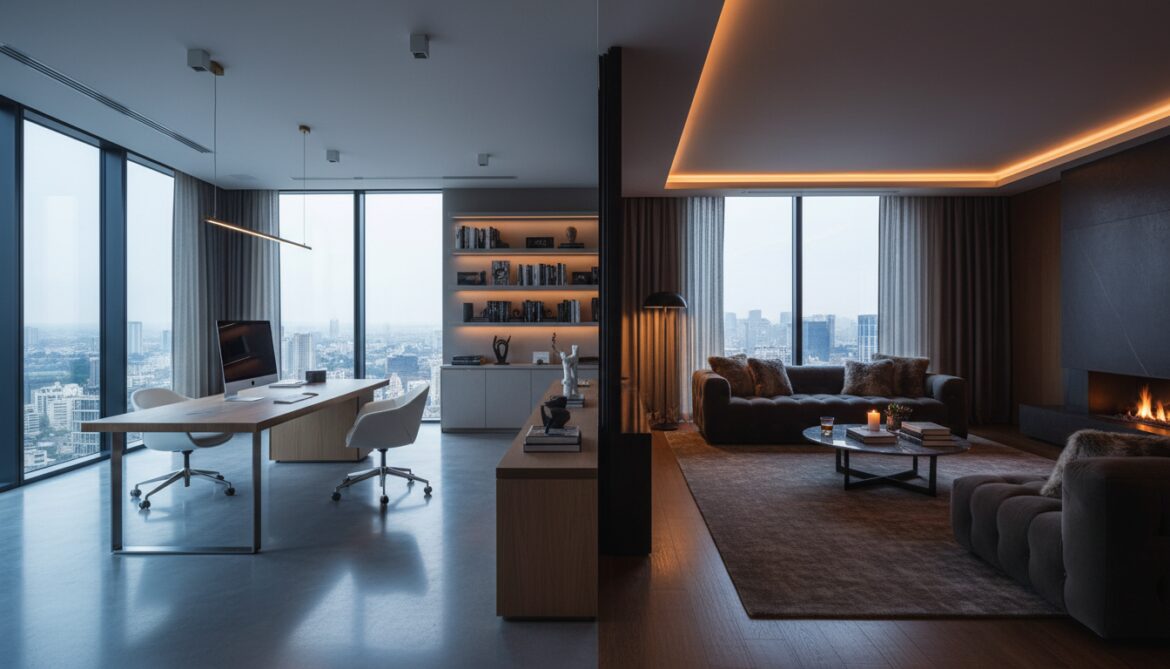
I used to be a purist.
I really did.
For the first decade of my career, I rolled my eyes at the “smart home” trend. It felt like a gimmick for tech bros who wanted to turn their living room purple with a voice command, or for people too lazy to walk three feet to a switch. It seemed sterile. It seemed unnecessary. It felt like the antithesis of the soulful, tactile interiors I spent years curating.
But I was wrong.
I wasn’t wrong about the purple light—that still looks terrible—but I was wrong about the utility.
The turning point wasn’t a gadget. It was a realization about biology. We have spent thousands of years evolving to sync with the sun, yet we spend our modern evenings bathing in static, aggressive 60-watt blasts that scream “noon” to our confused retinas at 10 PM.
Lighting isn’t just about seeing your coffee table. It is the invisible paint that dictates whether your home feels like a sanctuary or a waiting room.
If you are still flipping a single toggle switch and flooding your room with flat, uninspired brightness, you are missing half the design potential of your space.
The Science of “Vibe” (It’s Actually Biology)
You know that feeling when you walk into a fast-food joint at night? That anxious, alert feeling? That is high-Kelvin blue light doing its job. It suppresses melatonin. It tells your brain to hunt, gather, or file tax returns.
Now, imagine that same feeling in your bedroom when you are trying to wind down.
Disastrous.
This is where the concept of “Scenes” replaces the concept of “Switches.”
We need to stop thinking about lighting as “On” or “Off.” Nature doesn’t work that way. The sun doesn’t just click off; it fades. It shifts from the crisp, cool white of morning to the golden, amber hues of dusk.
Your home should do the same.
If you have been struggling with sleep, or if your beautifully curated room feels “off” despite having perfect furniture, the culprit is likely the color temperature of your bulbs. You are fighting your own biology with bad hardware.
For more about this topic, read: Warm vs Cool Lightbulb Temperature Guide
Designing The “Morning Protocol”
Mornings are rough. I don’t care how much matcha you drink; leaving a warm bed is a tragedy.
Your lighting needs to act as a gentle caffeine drip for your eyes.
When I design a morning scene for clients, I focus on “Cool White” temperatures. We are talking 3500K to 4500K. This is the spectrum that mimics mid-morning daylight. It triggers cortisol (the good kind that wakes you up) and improves focus.
But here is the trick: Do not set it to 100% brightness immediately.
A jarring blast of light is just as bad as a jarring alarm clock.
Your smart scene should fade in over 15 minutes. Start at 10% brightness in a warm tone, then shift gradually cooler and brighter.
The Decor Impact of Morning Light
This cool, crisp light is where your color choices actually survive or die. If you have jumped on the trend of using sage green or terracotta in your space, morning light is where these earth tones look most accurate.
Under a warm, yellow bulb, sage green turns into a muddy swamp color. Under crisp morning light, it reads true.
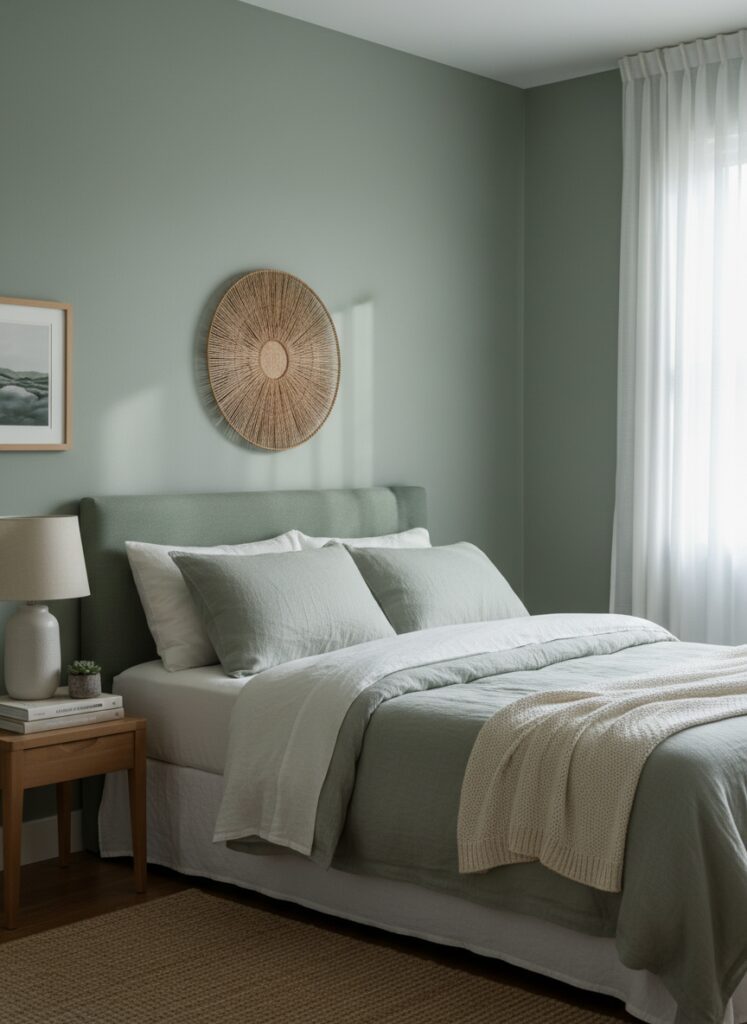
If you are working with a 60-30-10 color rule, the morning scene is where that balance is most visible. The contrast between your primary wall color and your accent pieces will be sharpest here. This is the mode for productivity.
This is also the best lighting for your home office. If you are trying to work in a “cozy” warm-lit room, you are going to feel lethargic by 2 PM. You need that blue-spectrum spike to keep your brain firing.
However, a warning for the minimalists: Cool light is unforgiving. It highlights dust. It highlights clutter. If you have a desk hidden in a broken-plan layout, morning light will expose every wire you haven’t managed.
You absolutely must get your cable management under control if you plan to use bright, cool lighting. Shadows from messy cords look like chaotic spiderwebs under high-kelvin bulbs.
Designing The “Evening Comedown”
This is my favorite mode. This is where the magic happens.
As soon as the sun goes down, your home should cease to be a place of work. It should become a cave. A very chic, well-appointed cave.
For the Evening Scene, you want to drop your Kelvin count down to 2700K or even 2200K. Think candlelight. Think fire.
This is not just about dimming the lights; it is about changing the quality of the light.
The “Pools of Light” Technique
The biggest mistake people make in the evening is trying to light the whole room evenly. Stop doing that.
Evening lighting should be about “pools.” You want a pool of warm light on your book. A pool of soft light highlighting a plant. A pool of light behind the sofa. The rest of the room should fall into shadow.
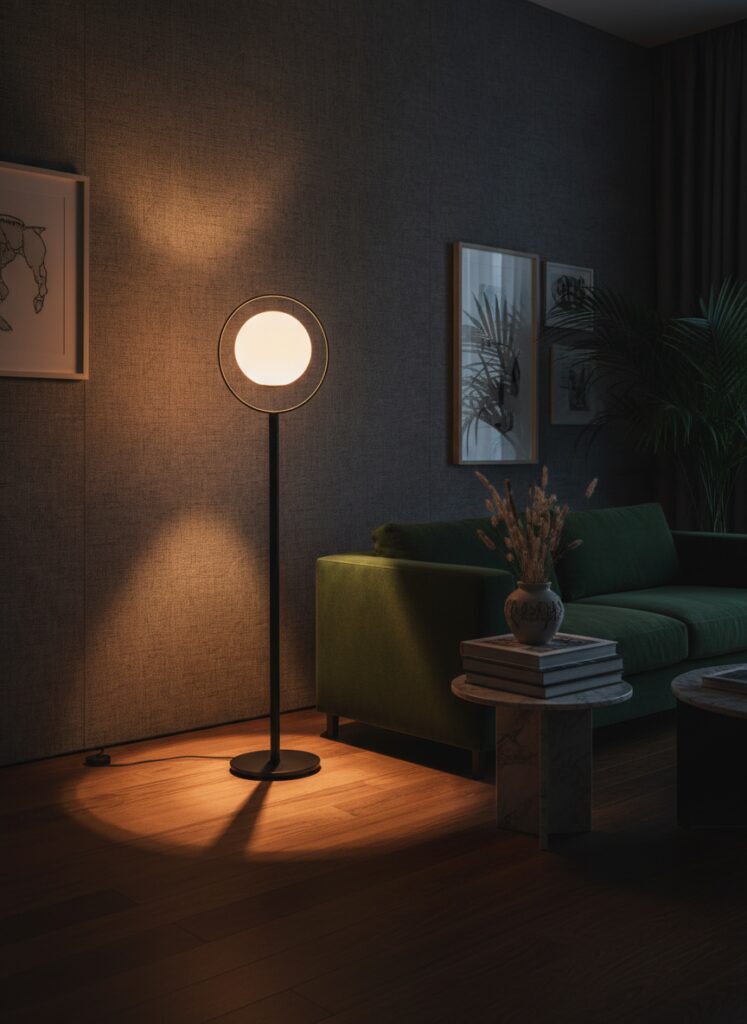
This technique is especially powerful if you have embraced moody maximalism or darker paint trends. Shadows create mystery. They blur the edges of the room.
If you have a small apartment or a studio, this is how you separate your “bedroom” from your “living room” without building a wall. You use light to micro-zone the space. When the work day is done, the kitchen lights go off, the desk lamp dies, and only the living area glows.
Texture and Warmth
Warm light loves texture.
If you have a wall with significant texture—maybe a plaster finish or a slat wall—warm light grazing it from the side creates deep, dramatic shadows that make the material look expensive.
This is where monochromatic designs truly shine. Without color contrast, you need shadow contrast. A warm, dim bulb hitting a bouclé chair or a velvet sofa creates a tactile richness that flat overhead lighting destroys.
If you have curved furniture, position your floor lamps to accentuate those organic lines. The soft gradient of a smart bulb dimming on a curve is incredibly soothing to the eye.
The Hardware Aesthetics (Hiding the Ugly Stuff)
Here is the problem with smart lighting: The gear is usually ugly.
Plastic hubs, blinking LEDs, white plastic speakers. It ruins the vibe.
You cannot have a vintage-inspired aesthetic and then plop a futuristic white puck on your antique sideboard. It breaks the immersion.
The “Trojan Horse” Method
I am a huge advocate for hiding smart speakers and hubs inside vintage decor.
I have hidden smart hubs inside hollowed-out books. I have tucked voice assistants inside ceramic bowls or behind trailing ivy on a bookshelf. You want the functionality, not the visual clutter.
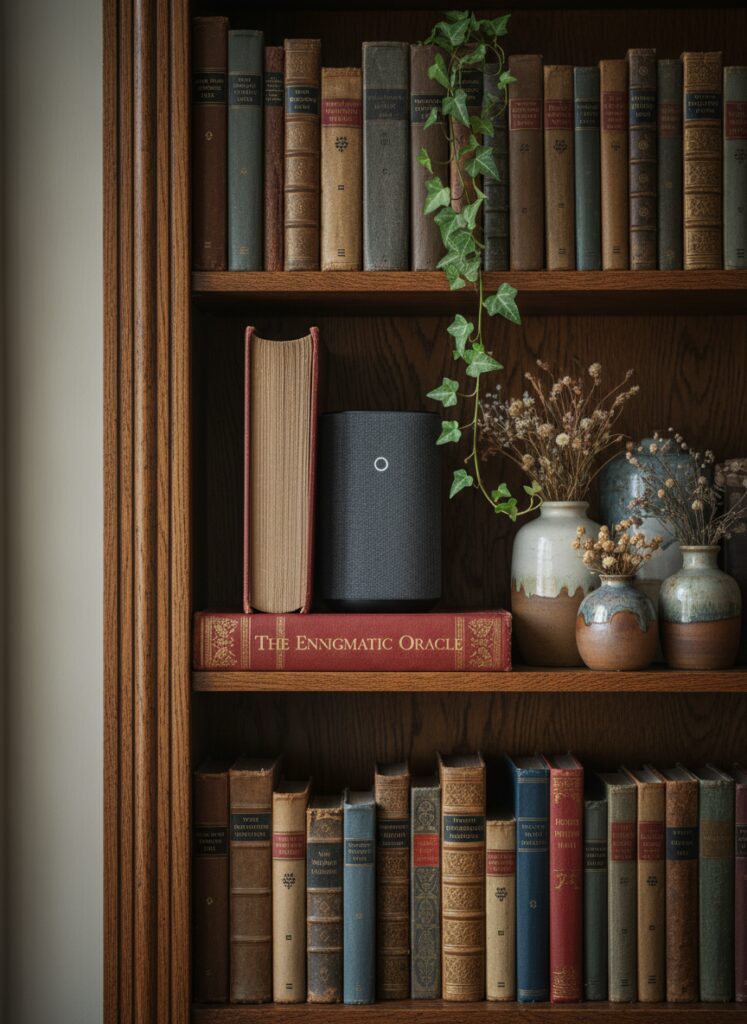
Biophilic design helps here, too. If you are leaning into living walls or heavy plant coverage, you can easily camouflage sensors and hubs behind the foliage. Just make sure you aren’t blocking the microphones if you use voice control.
The Bulb Dilemma
For the bulbs themselves, you have two choices:
- Smart Bulbs: The bulb connects to the wifi/hub.
- Smart Switches: The switch connects, the bulb is dumb.
If you live in a rental, renter-friendly lighting hacks usually rely on smart bulbs because you can’t rewire the switches.
However, if you have exposed bulbs (like in a sputnik chandelier or a clear glass pendant), standard smart bulbs look hideous. They have ugly plastic bases that cover half the glass.
You must buy “Edison-style” or “Filament” smart bulbs for these fixtures. They allow you to have that vintage look while still controlling the color temperature. Do not compromise on this. A plastic bulb in a glass fixture looks cheap. Period.
Where People Mess This Up
I see the same three mistakes over and over again.
1. The “Hospital” Ceiling
People buy smart bulbs, screw them into their recessed ceiling cans, and run them at 5000K because it feels “clean.”
It doesn’t feel clean. It feels like an operating theater.
Overhead lighting is generally unflattering. It casts shadows under your eyes (hello, dark circles) and flattens out your furniture.
Use your ceiling lights sparingly. Rely on floor lamps, table lamps, and sconces. If you have painted your ceiling a dark color, remember that it will absorb light. You need more lumens to light the room, but keep them warm. A dark ceiling with cool, bright light looks like a stormy sky in a bad way.
2. The Color Temperature Clashes
Nothing makes a room look more chaotic than having one lamp at 3000K (warm white) and another at 5000K (cool daylight).
It creates a subconscious visual dissonance. It feels “messy” even if the room is tidy.
Your smart scenes must sync everything. When you trigger “Evening Mode,” every single bulb needs to shift to warm amber simultaneously. If you have a rogue daylight bulb in the hallway, it will stick out like a sore thumb and ruin the transition.
3. Ignoring the Setup
You buy the bulbs, you install them, and then you use the wall switch to turn them off.
Congratulations, you just broke your smart home.
If you cut the power at the switch, the automation dies. You have to commit to using the app, voice control, or—my preference—wireless smart buttons mounted next to the real switch.
This is a behavior change. If you have guests or family members who refuse to play along, it will be frustrating. You might need to cover the original switches or use a specialized cover plate to keep people from physically cutting the power.
Why This Matters for Small Spaces
If you are living in a tight footprint, lighting is your only way to expand the space visually.
During the day, bright, cool light bouncing off mirrors can trick the eye into thinking the room is double the size. It pushes the walls back.
At night, bringing the light down to low levels blurs the corners. You can’t see how small the room is if the perimeter is in shadow.
If you are trying to fake an entryway in a living room that doesn’t have one, lighting is the key separator. A dedicated lamp on a console table by the door creates a “landing strip” moment. When that light is on, it’s an entry. When it’s off, it joins the living room.
The Final Verdict
Smart lighting isn’t about being lazy. It is about reclaiming your natural rhythm in an artificial box.
It is about realizing that your drywall and your sofa are static, but you are dynamic. You change throughout the day, and your home should change with you.
Don’t settle for static lighting. It’s unnatural.
Buy the bulbs. Hide the hubs. Program the scenes. And for the love of design, stop using 5000K light after sunset.