
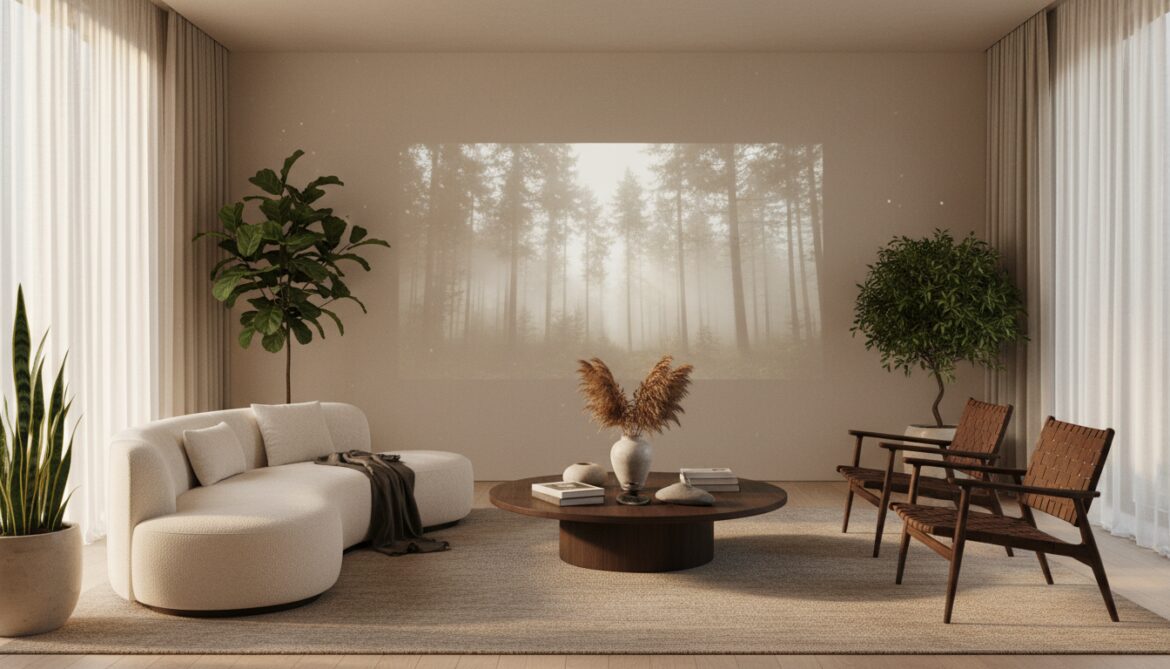
I have been fighting a losing battle against the “black void” for fifteen years.
You know exactly what I’m talking about. You spend months curating a room. You pick the perfect vintage rug, you agonize over the textural difference between bouclé and velvet, and you finally nail that moody, organic vibe. Then, smack in the center of your focal wall, you mount a giant, glossy, soulless black rectangle. It sits there like a void, sucking the life and energy out of your carefully plotted aesthetic. We have turned our living rooms into shrines dedicated to technology, orienting every single piece of furniture toward an appliance that is ugly 90% of the time.
I used to think the answer was hiding the TV in a cabinet, but let’s be real. Nobody actually closes those cabinet doors.
We leave them open because we are lazy, and the black hole stares back at us anyway. Recently, however, I’ve noticed a shift. People are finally fed up. The rebellion against the “TV shrine” is here, and the weapon of choice isn’t a better TV—it’s a projector. But before you go toss your flatscreen on the curb, you need to understand that designing for a projector is an entirely different beast than designing for a television. It is messy, it is finicky, and if you get it wrong, it looks like a college dorm room rather than a high-end lounge.
The Invisible Cinema
Why does this swap feel so liberating?
Because when a projector is off, it is truly off. It vanishes. You are left with a wall. A beautiful, blank canvas that allows your eye to travel to the art, the plants, or the architectural details rather than getting snagged on a reflective piece of plastic. This invisibility allows for a layout revolution.
When the screen doesn’t exist until you press a button, you stop pointing your sofa at the wall by default. You can embrace a layout that prioritizes conversation. You can finally lean into that broken-plan living room concept where zones are defined by rug placement and furniture grouping rather than the viewing angle of the latest Marvel movie.
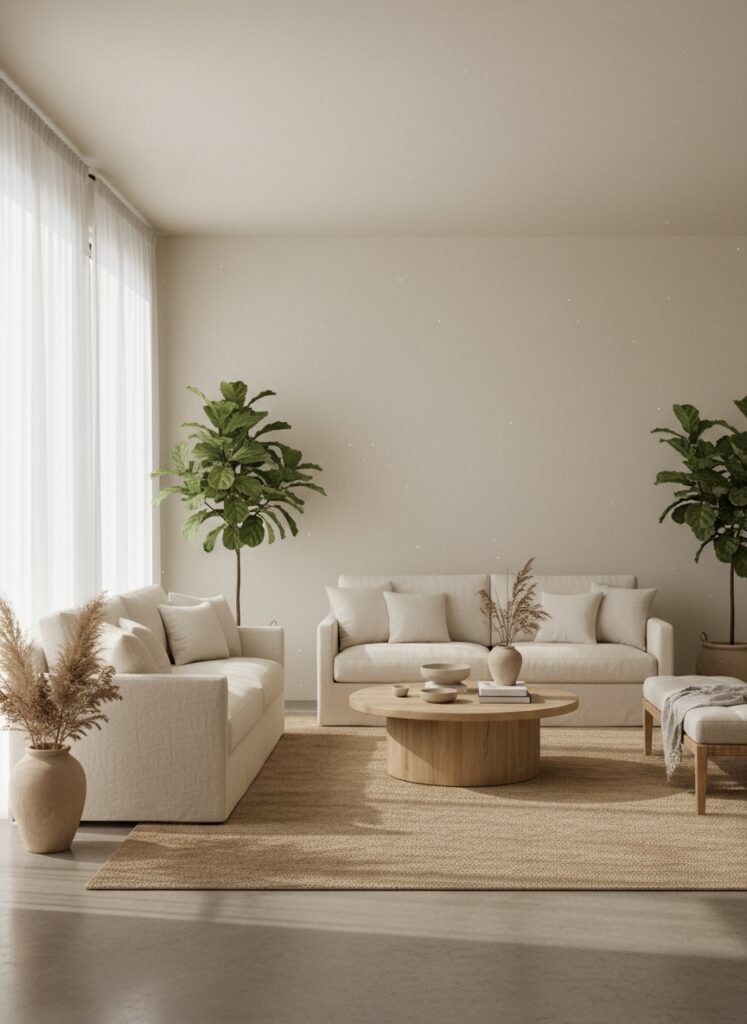
But the trade-off is control. A TV fights the sun and wins; a projector fights the sun and loses miserably. Choosing this path means you are no longer just an interior decorator; you are now a lighting engineer.
Lighting: The Make or Break Factor
If you value natural light above all else and have floor-to-ceiling windows with no curtains, stop reading. Keep your TV. A projector demands darkness, or at least a very specific type of dimness, to function.
This is where your lighting scheme becomes the most important element of the room. You can’t just slap a dimmer switch on the wall and call it a day. You need layered control. I always tell clients that smart lighting scenes are the secret sauce here. You need a “Cinema” scene that kills the overheads but keeps a low-level, warm glow in the corners so you don’t trip over the dog.
For more about this topic, read: Smart Lighting Scenes for Morning and Evening Wellness
Speaking of glow, the temperature of your bulbs matters more here than anywhere else. If you use cool white bulbs, your room will feel like an operating theater the moment the movie stops. You want warm white temperatures that mimic the cozy, incandescent vibe of a traditional theater.
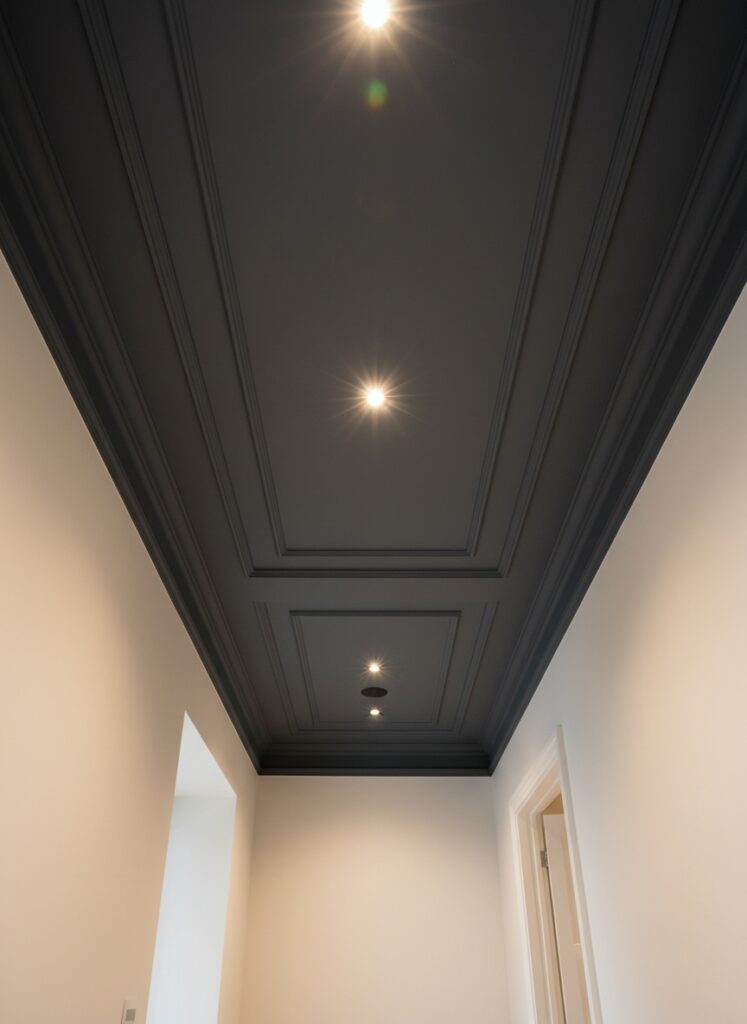
Here is a trick veteran designers use: paint your ceiling dark.
Most people ignore the “fifth wall,” leaving it stark white. But if you are using a projector, a white ceiling is a disaster. It reflects the light from the screen back down into the room, washing out the image you just paid thousands of dollars to project. By embracing dark ceiling paint trends—think charcoal, deep navy, or even a soft black—you absorb that scatter light. It boosts the contrast of your image and, arguably more importantly, makes the room feel infinitely moodier and taller.
The Wall is Not Just a Wall
You have two choices: a retractable screen (which is ugly) or projecting directly onto the wall.
I prefer the wall. It feels more organic, more intentional. But you cannot project onto just anything. If you are obsessed with those heavy texture trends or have a wall covered in lumpy plaster, you are in for a bad time. Texture creates tiny shadows in the image. You will see every bump on Brad Pitt’s face, and not in a high-definition way.
The surface must be smooth.
However, “smooth” creates a design conflict. We want our walls to have depth. If you are projecting on a wall, that wall generally needs to be a specific shade of grey or white to capture the color accuracy. This can clash if you are trying to implement a warm, earthy palette like terracotta or sage green. You can’t project onto a terracotta wall; everyone will look sunburned.
The workaround? Color blocking. Use the 60-30-10 rule for your color balance. Make the projection surface your neutral 30%, and flank it with your bold terracotta or sage colors on the adjacent walls or built-in shelving. This frames the “screen” without forcing you to live in a grey box.
Managing the Spaghetti
Here is the dirty secret of projectors: the cables are a nightmare.
With a TV, the cables are behind the unit. With a projector, the source is often on the ceiling or the back of the room, while the sound needs to come from the front. You end up with wires traversing the entire length of your space.
If you are renting, you can’t just rip open the drywall. You need to get creative with vertical storage and shelving. High bookshelves are your best friend. You can place the projector on a high shelf, run the power cable down the back of the unit, and use cable raceways painted the same color as the wall to hide the run to the outlet.
And what about the sound? Projector speakers are garbage. They sound tinny and distant. You need a soundbar or external speakers at the front of the room. But again, we are trying to avoid the “tech shrine” look.
I love hiding smart speakers and sound equipment inside vintage decor or blending them into a bookshelf display. A black mesh speaker disappears when placed next to dark, hardcover books or inside a wire basket. It’s about camouflage.
Furniture That Flows
Since you don’t have a TV anchoring the room, your furniture doesn’t need to be pushed against the walls. This is the perfect excuse to float your furniture. Pull the sofa into the center of the room.
Because the screen is projected high, you don’t need a low-profile media console. You can use a beautiful antique credenza, a fake fireplace mantel, or even a bench with biophilic elements like plants (just make sure the ferns don’t grow into the projection beam).
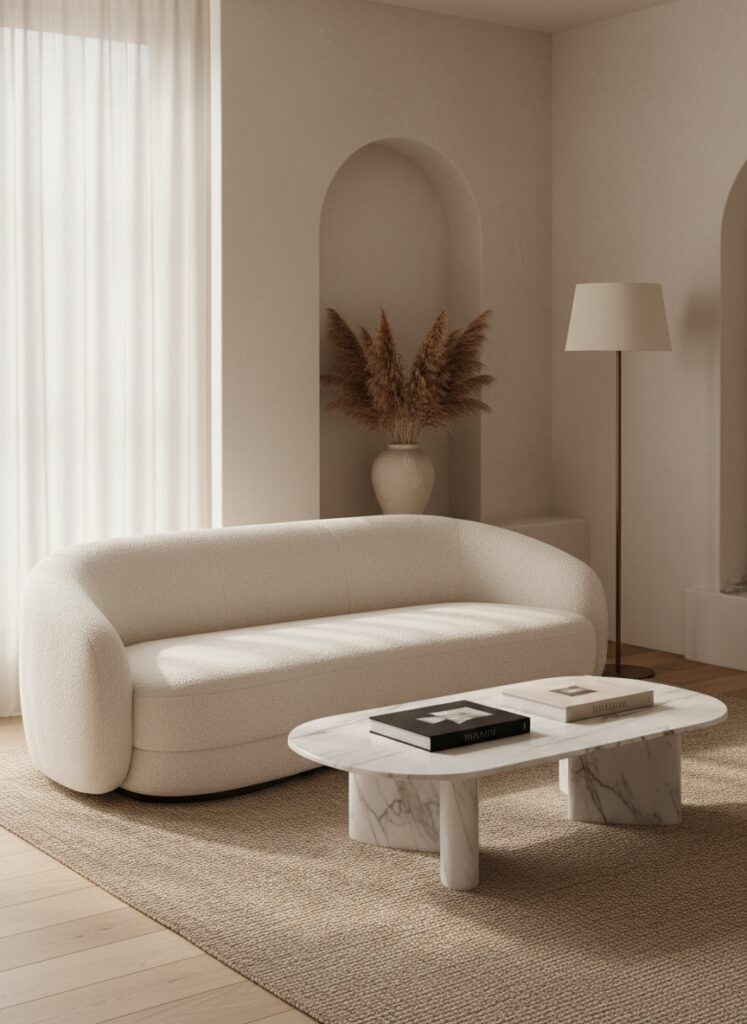
This setup also plays incredibly well with the current obsession with curved furniture. A curved sofa softens the room and directs the gaze inward toward guests, rather than rigidly facing the wall. It creates a “conversation pit” vibe that instantly feels more high-end than a standard row of recliners.
If you are in a small studio, this flexibility is a lifesaver. You can use micro-zoning tips to separate the sleeping area from the living area, knowing that you don’t need a massive wall for a TV stand. The “screen” can project onto a roll-down blind over a window if you are truly tight on space.
Where People Mess This Up (Don’t Do This)
I see people attempt the projector lifestyle and fail because they ignore the physics of the situation. Here are the three ways you will ruin this design:
1. Ignoring the “Throw Distance” You buy a projector, bring it home, set it on your coffee table, and realize the image is only 30 inches wide. Or it’s blurry. Every projector has a specific throw distance ratio. You cannot just guess. If you have a small room, you need a “short-throw” projector that sits inches from the wall. If you have a deep room, you need a standard throw. If you get this wrong, you will have a tiny screen or a projector sitting in the middle of your walking path.
2. The Mirror Disaster Mirrors are fantastic for making small rooms look bigger. We know this. But if you hang a giant mirror on the wall opposite your projector screen, you are going to reflect the flickering light of the movie right back into your eyes. It is distracting and annoying. Be careful with reflective surfaces. Matte finishes are your friend here.
3. Forgetting the Noise Projectors have fans. Bright projectors have loud fans. If you mount a cheap projector directly above your head on the sofa, your quiet indie drama is going to be accompanied by the sound of a jet engine taking off. You need to spend the money on a quiet model, or house the projector in a ventilated cabinet to dampen the sound.
4. The “Blue Light” Trap We talk a lot about using blue in design for anxiety relief, which is valid for paint and textiles. But projectors emit a lot of blue light. If you watch late at night, it can mess with your sleep just as bad as a phone screen. This is why bias lighting (LED strips behind the screen area) or warm ambient lamps nearby are key to softening the contrast and reducing eye strain.
The Verdict
Ditching the TV is not for everyone. It requires more effort, more money, and more planning than simply plugging in a Samsung and calling it a day.
But the result?
You get a living room that feels like a home, not an electronics store. You get a space that prioritizes texture, color, and conversation until the lights go down. Then, and only then, does it become a theater. That kind of magic is worth hiding a few cables for.