
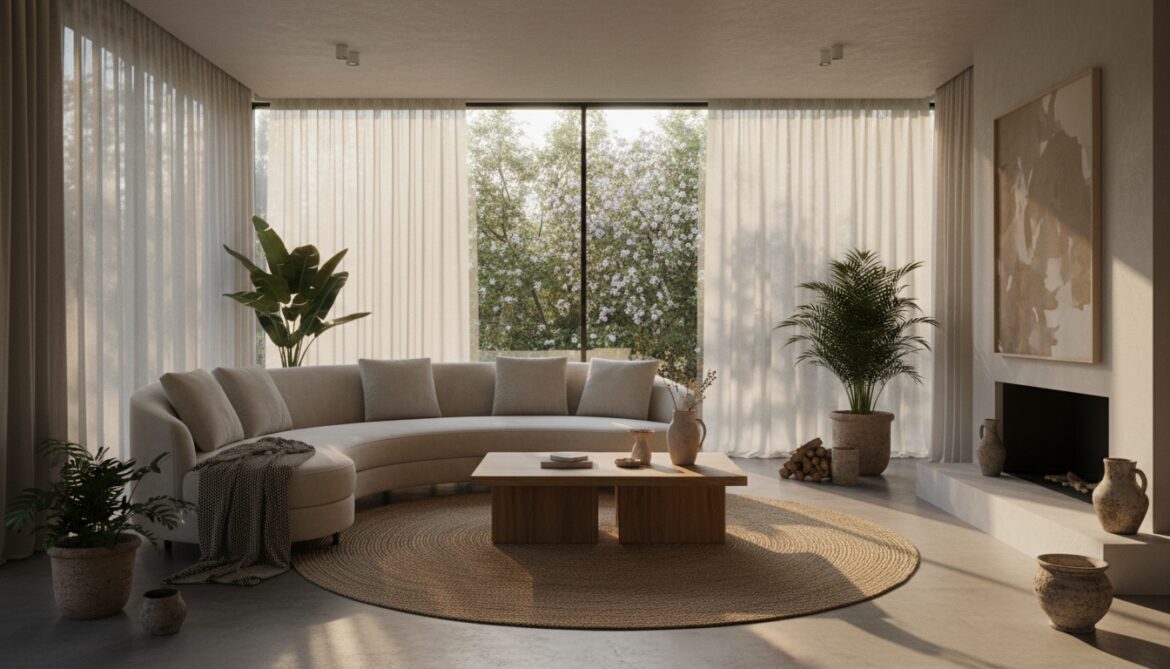
I spent the first five years of my design career rolling my eyes at Feng Shui.
I thought it was total nonsense. It felt like a marketing gimmick designed to sell wind chimes to people who were actually just suffering from bad architecture. But then, somewhere around my hundredth client consultation, I realized something uncomfortable. The homes that felt “right”—the ones where people actually slept well and didn’t hate their spouses—followed Feng Shui principles almost by accident. The homes that felt like anxious waiting rooms? They broke every rule in the book.
It isn’t magic. It isn’t about buying a three-legged toad statue to get rich.
It is simply the psychology of space. It is the logical arrangement of objects to stop your brain from firing constant “fight or flight” signals because your sofa has its back to the front door. If your home makes you tired, angry, or confused, your energy flow is blocked. Let’s fix it without the woo-woo.
Understanding the “Flow” (Without the Crystals)
Think of energy, or “Qi,” exactly like water.
Imagine a garden hose turned on at your front door. If the water flows gently into the living room, meanders around the sofa, and pools softly in the reading nook, that is good. That is a relaxing home.
Now, imagine your current hallway.
Does that water blast in like a firehose because there is no entryway landing strip to slow it down? Does it slam immediately into a wall? Does it get trapped in a clutter-dam of shoes and Amazon boxes? If the “water” moves too fast, you feel rushed. If it gets stuck and goes stagnant, you feel lethargic and depressed.
You have to manipulate this flow.
In spaces with oppressive architecture, like basements or apartments with low ceilings, the energy feels compressed. It pushes down on you. You have to visually lift that weight using vertical lines or low-profile furniture to let the energy circulate, rather than hanging heavy fixtures that decapitate the room. It’s physics, practically.
The Command Position: Stop Hiding
The single most important concept you need to learn is the Command Position.
It triggers a primal safety mechanism in your lizard brain.
Here is the rule: You must be able to see the door from where you spend the most time (bed, desk, stove), but you should not be directly in line with it. If your back is to the door while you are working, your subconscious is constantly scanning for threats behind you. You cannot focus. You will feel low-grade anxiety all day.
For the Home Office: This is non-negotiable for a human-centric home office. If you are staring at a blank wall, spin your desk around. “Float” it in the room. If you are in a tiny box room, place a mirror on your monitor or wall so you can see the reflection of the door behind you.
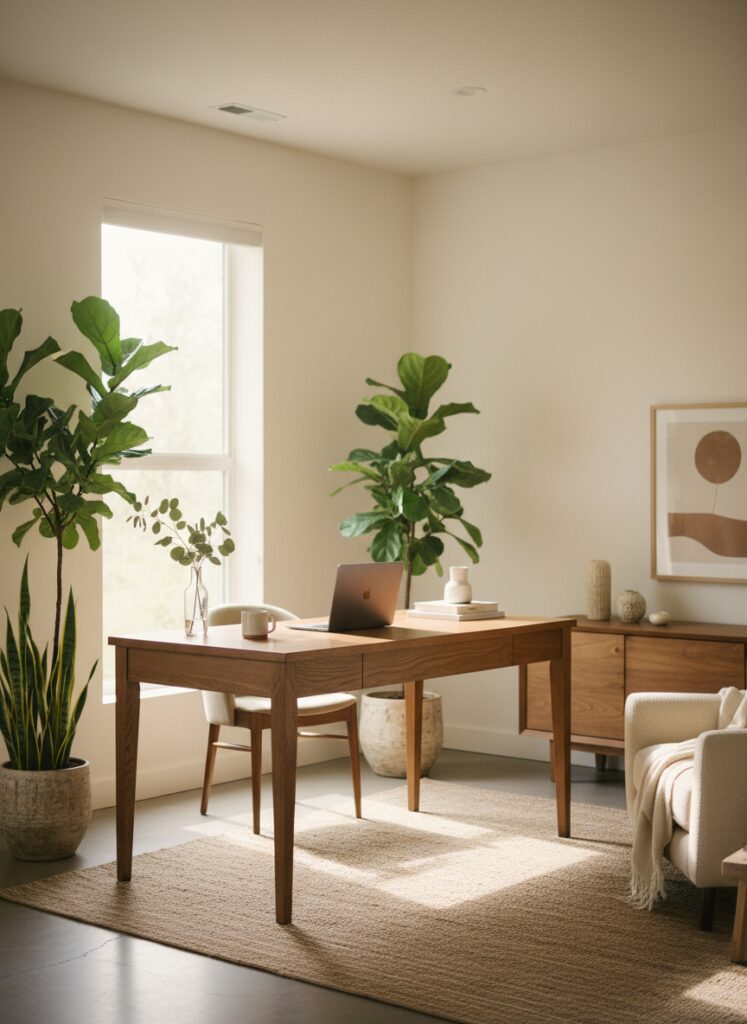
For the Living Room: Do not float your furniture aimlessly if the room is small. However, floating furniture arrangements often work better than pushing everything against the walls, which creates a weird, dead space in the middle of the room where energy moves too fast. Anchoring the sofa so you can see who enters the room gives you power.
Balancing Yin and Yang Through Lighting and Tech
Lighting is not just about seeing your dinner; it’s about controlling the room’s heartbeat.
Yang is bright, active, and loud. Yin is dark, soft, and quiet. Most modern homes are way too Yang. We have bright white LEDs screaming at us at 10 PM. This destroys your circadian rhythm and your home’s energy balance.
You need to lean into smart lighting scenes.
In the morning, you want cool, bright light (Yang) to wake up. By sunset, your home should transition to warm, dim amber light (Yin). Understanding the warm vs. cool white lightbulb temperature spectrum is the difference between a hospital waiting room and a sanctuary.
The Tech Problem: Televisions and computers are massive energy drains. They are black holes.
A giant black rectangle in the center of your living room dominates the Qi. It demands attention even when it’s off. This is why I prefer a projector over a TV in many designs; when the projector is off, the screen rolls up or vanishes against the wall, leaving the energy calm.
If you must have gadgets, hide them.
Visible chaotic wires represent tangled nerves. It is visual noise. Good cable management is good Feng Shui. If you have a smart speaker, don’t leave it sitting out like a plastic sore thumb. Camouflage it. Blending smart speakers into vintage decor helps technology feel less invasive and more grounded.
Materiality: Wood, Earth, and Avoiding the “Sterile” Look
Modern builds often feel soulless because they lack the Wood element.
Wood represents growth, vitality, and flexibility. But be careful. Fast furniture made of particleboard and plastic veneer doesn’t carry the same energy. It feels temporary. It feels cheap.
There is a distinct energy to quality wood furniture, even if you find it thrifting. Old wood has a story. It grounds the room.
If you can’t afford solid walnut, that’s fine. You can make IKEA furniture look custom with hacks that add texture and weight, making the pieces feel more permanent and substantial.
Color as Energy: Color is the fastest way to shift the vibration of a room.
- Earth Element: Terracotta and Sage Green are massive right now for a reason. They are grounding. They connect you to the soil and nature.
- Water Element: Deep blues are introspective. If you are high-strung, incorporating blue interior design can physically lower your heart rate. It’s great for anxiety relief.
- Metal Element: White, grey, and metallics. Good for focus, but too much makes a room feel cold and rigid.
For a balanced palette, I often use the 60-30-10 rule. 60% grounding color (neutral), 30% secondary color (perhaps a wood tone or sage), and 10% accent (a metallic or bold punch).
The Shape of Things: Cutting the Poison Arrows
In Feng Shui, sharp corners pointing directly at you are called “Sha Qi” or poison arrows.
Sit on your sofa. Look around. Is the sharp corner of a coffee table pointing directly at your knees? Is the edge of a pillar slicing through your visual field? These sharp lines create subconscious discomfort.
This is why curved furniture and organic design are taking over. A kidney-shaped sofa or a round coffee table allows energy to flow around it like water around a river stone. It softens the room.
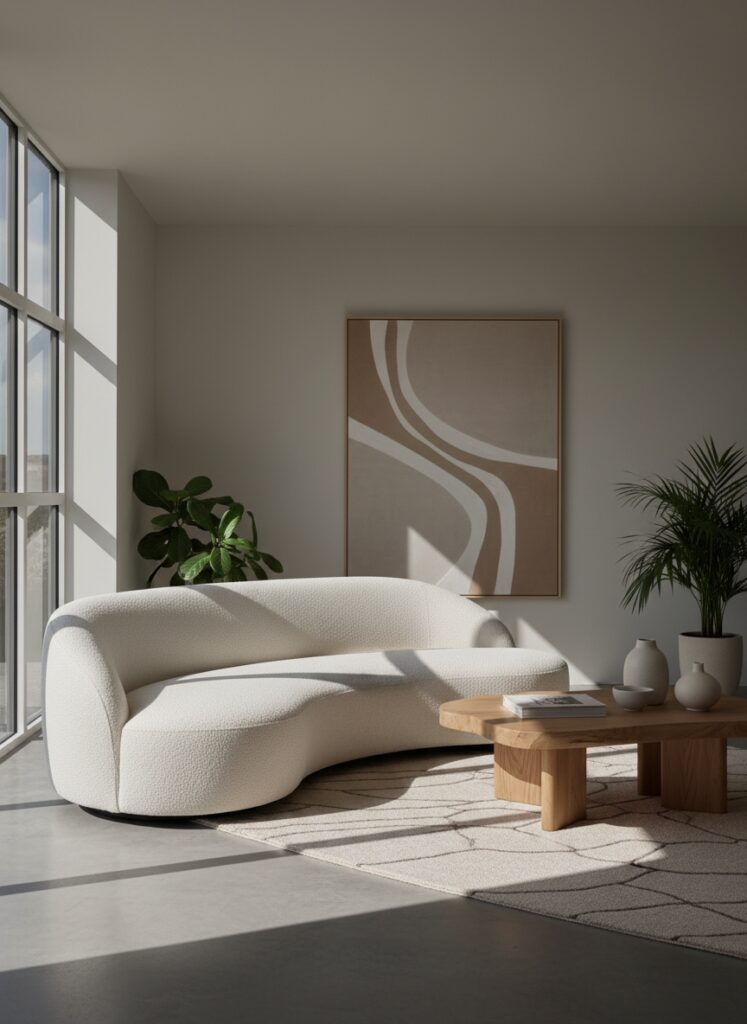
If you have a boxy room with hard angles, use plants. Biophilic design and living walls soften those corners. A tall plant in a corner stops energy from stagnating there.
Zoning the Flow: In open-concept spaces (especially studio apartments), the energy can feel overwhelming because everything happens at once. You sleep where you eat.
You need micro-zoning. Use rugs, open shelving, or screens to create “rooms” within the room. This creates a broken plan living room layout. It creates barriers that slow down the energy flow, making the space feel cozy rather than chaotic.
Common Mistakes That Ruin the Vibe
You can paint your walls the perfect shade of green and still wreck the room with these three errors.
1. The “Solitary Hero” Art Disaster I see this constantly. Someone hangs a single, small piece of art on a giant wall. Or worse, the art depicts a lonely, solitary figure walking in the rain.
What you look at, you become.
If you want connection, display art that shows connection. If you want abundance, don’t leave massive empty walls that scream “scarcity.” The art display trends moving toward 2026 are shifting, but the principle remains: scale matters. Don’t be afraid of a gallery wall, but curate it. Avoid “sad” art in the bedroom.
2. The Mirror Trap Mirrors are the aspirin of interior design; they cure a lot of headaches, especially when trying to make a small room look bigger. But they double whatever they reflect.
Do not hang a mirror that reflects your cluttered desk. You are just doubling your workload. Do not hang a mirror facing the toilet. Just don’t. Do not hang a mirror facing your bed if you have trouble sleeping. Some schools of thought say it bounces your energy back at you, keeping you awake.
3. Ignoring the “High-Low” Balance A room full of brand-new, expensive items feels like a showroom, not a home. It lacks soul. A room full of cheap items feels unstable.
You need high-low living room decor.
Mix the expensive velvet sofa with a vintage rug. Mix the sleek modern lamp with a beat-up wooden stool. This tension creates life. It relates closely to Japandi design, which merges the modern slickness of Scandi with the imperfect, weathered nature of Wabi-Sabi. The imperfection allows you to relax. If everything is pristine, you will be on edge, terrified of spilling a drop of wine. That is bad Qi.
For more about this topic, read: Modern Mid-Century Interior Design Guide
Storage: The Enemy of Anxiety
You cannot have good energy flow if you have piles of junk on the floor.
Floor clutter blocks the “water.” It creates stumbling blocks. If you are tripping over shoes, your life will feel like a series of stumble-blocks.
Use vertical storage. Get things up off the floor and onto the walls.
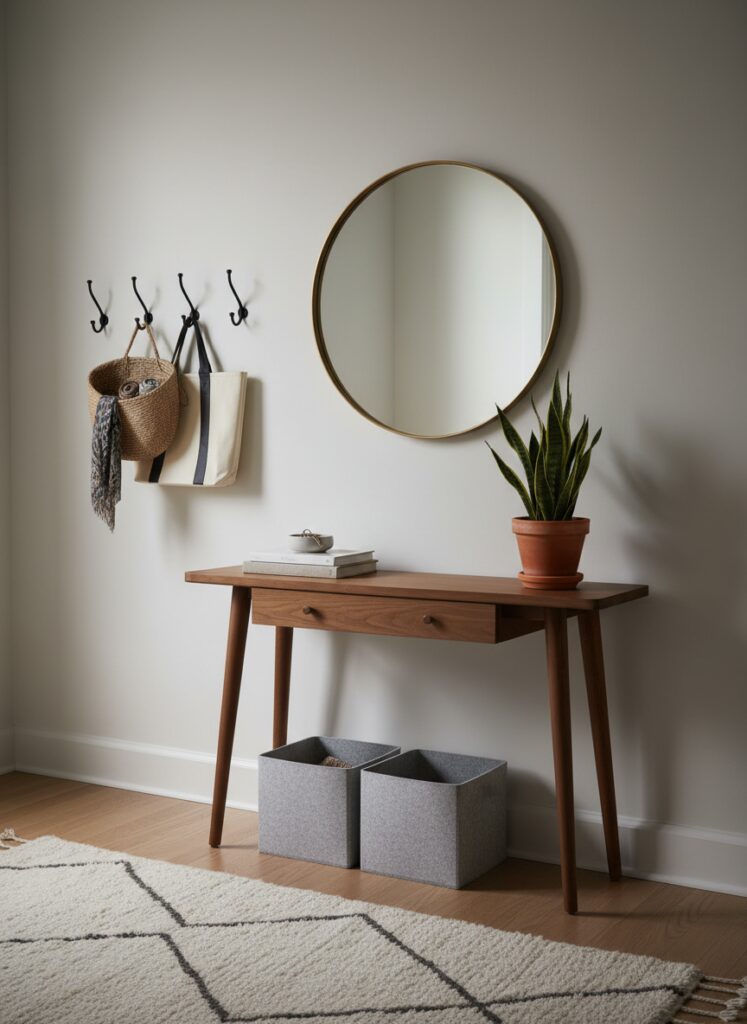
If you are renting, look into renter-friendly lighting and storage hacks. You don’t need to drill massive holes to create order. Even a fake entryway created with a slim console table and some hooks can stop the energy (and the mail) from spilling into the rest of the living room.
Just Move the Sofa
You might still be skeptical.
You might think I’ve been smelling too many sage sticks. That is fine. But I challenge you to do one thing this weekend. Look at your living room. Identify the sharpest corner pointing at you. Identify the dark, stagnant corner where the dust bunnies live.
Move one lamp. Round off one corner with a plant. Clear the floor.
See if the air doesn’t feel a little lighter in there.