
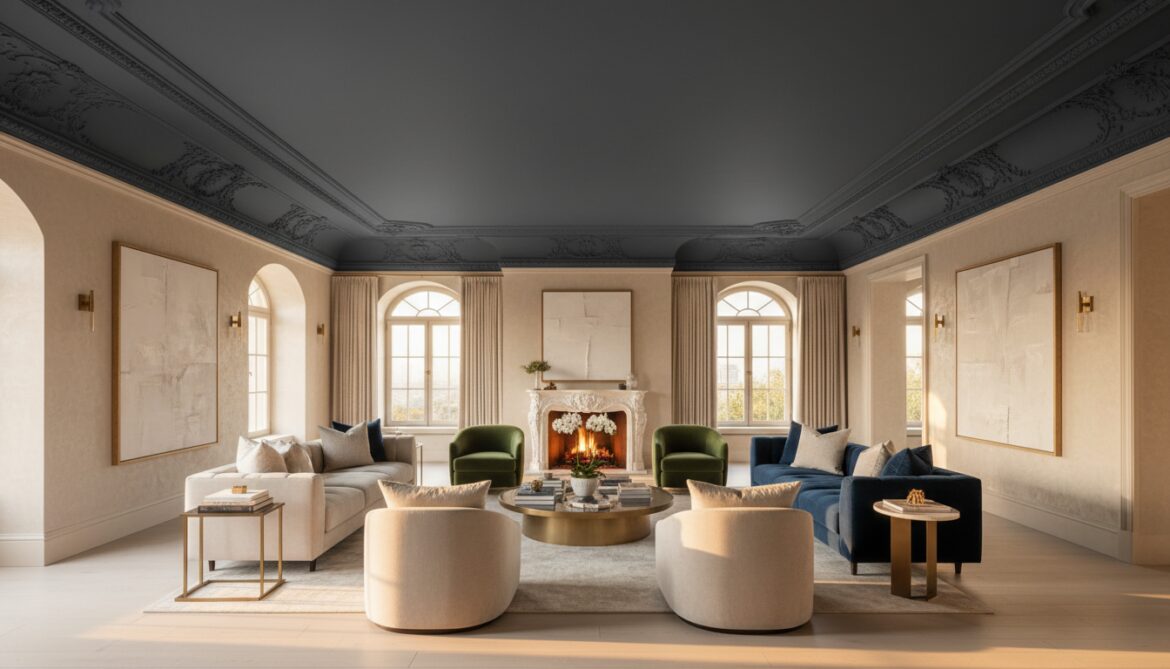
The “White Ceiling Default” is Lazy Design
I have painted probably three hundred ceilings in my career, and for the first decade, I barely looked up. I just dipped the roller in “Ceiling White”—that soulless, chalky standard—and went to work. We are culturally brainwashed to believe the “fifth wall” must remain pristine to keep the sky from falling on our heads. It’s the path of least resistance. It feels safe. It is also, quite frankly, a massive missed opportunity that screams of builder-grade boredom.
A stark white ceiling in a room full of rich, thoughtful decor is like wearing white athletic socks with a tuxedo. It draws the eye upward, but for all the wrong reasons. It creates a harsh visual stop.
Recently, I walked into a client’s dining room where they had painted the ceiling a deep, velvety charcoal. It didn’t feel like a cave. It felt like a warm hug. It changed my entire perspective on vertical volume. If you are terrified that a dark ceiling will make your house look like a dungeon, you are looking at it wrong. The dark ceiling doesn’t close the room in; it makes the boundaries of the room disappear into the ether.
Why The “Cave Effect” is Actually a Good Thing
We spend so much energy trying to make rooms feel “light and airy” that we forget the value of “grounded and secure.” There is a psychological weight to a room with a dark lid that actually helps with relaxation.
Think about the night sky. Is it claustrophobic? No. It’s infinite.
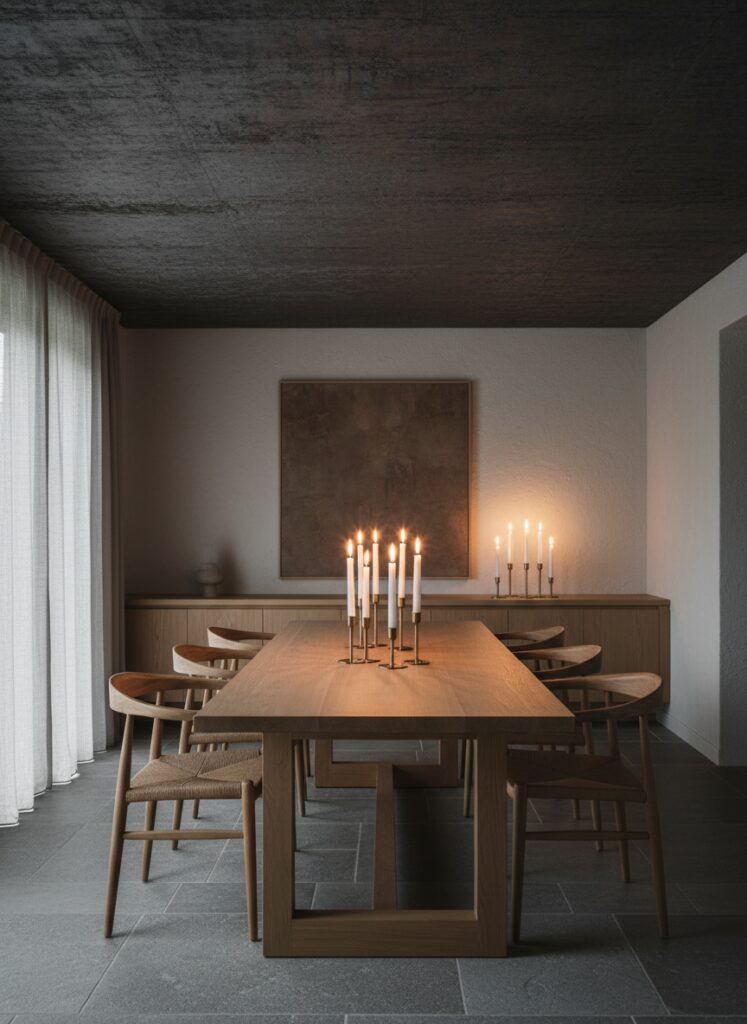
When you paint a ceiling black, navy, or a deep forest green, you are effectively deleting the visual boundary where the wall ends and the roof begins. In a room with white ceilings, your eye automatically tracks the corners. You can map the dimensions of the space instantly. 4 walls. 1 ceiling. Done.
But when that ceiling goes dark, specifically in a matte finish, those corners blur. The sharpness fades. The room feels less like a box and more like a continuous, enveloping atmosphere. This is the core philosophy behind the evolution of Japandi design into moody minimalism. We are moving away from sterile white boxes toward spaces that hold us.
For people who struggle with overstimulation, this is huge. There is a reason blue interior design is linked to anxiety relief. Darker, cooler tones on the ceiling lower the visual “temperature” of the room. It stops the glare. It absorbs the chaos.
The Execution: How to Do It Without Ruining Your House
You cannot just slap black paint on the ceiling and call it a day. You have to be strategic, or you will end up with a room that feels like a teenager’s basement.
1. The Finish Matters More Than the Color
Here is the hill I will die on: Never use gloss on a dark ceiling.
Unless you live in a pre-war Parisian apartment with plasterwork smooth enough to skate on, do not do it. Dark colors absorb light, but high-gloss finishes reflect it. If your drywall has even a single seam that isn’t perfect, a glossy dark paint will highlight that ridge like a neon sign. It looks cheap.
You want flat or matte paint. You want the ceiling to look like velvet, absorbing the light so the surface disappears. This texture management is key to mastering monochromatic design. If the ceiling has no shine, it has no defined depth, which creates that “infinite void” effect we are chasing.
2. Picking the Right “Dark”
Black is the default boldness, but it isn’t your only option.
- Sage Green and Terracotta: If you are chasing those current nature-inspired trends, a dark mossy green or a burnt rusted orange on the ceiling brings the outdoors in. It feels organic.
- Navy and Midnight Blue: These are safer stepping stones. They read as “neutral” in the evening but provide color during the day.
- Charcoal: Less harsh than pure black, softer on the eyes, and plays nicer with light gray walls.
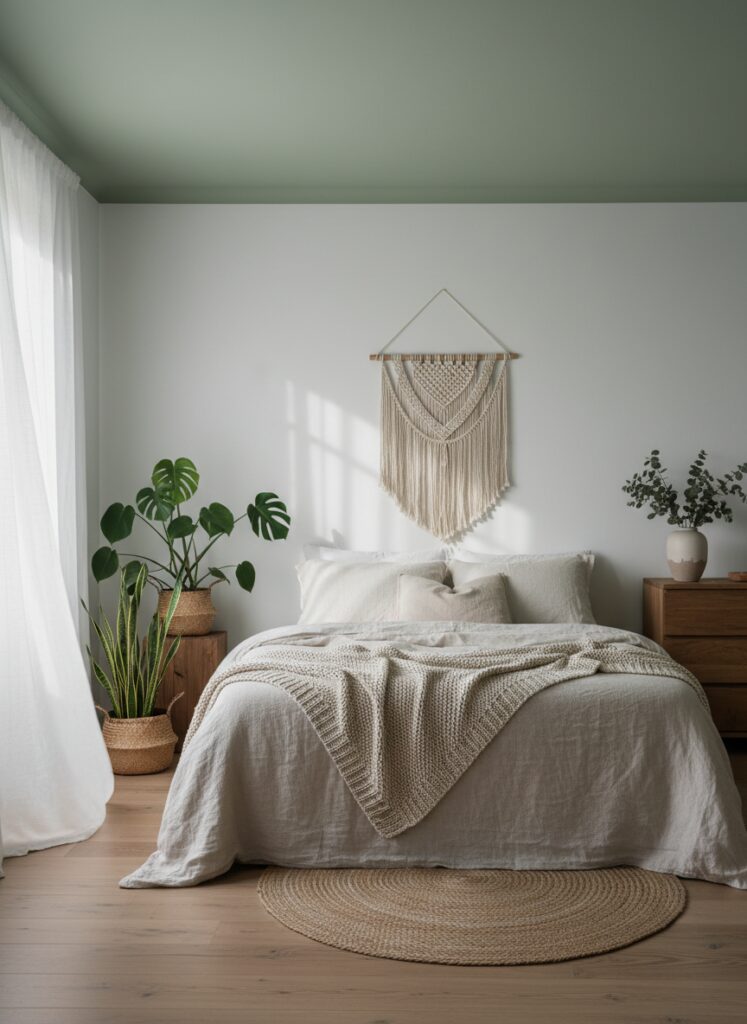
If you are following the 60-30-10 rule, your ceiling becomes the “30” or even the “60” if you are brave enough to color-drench the walls to match.
3. Lighting is Non-Negotiable
You are removing a massive reflector from your room. A white ceiling bounces light down; a dark ceiling eats it. You must compensate.
This is where you have to understand warm vs. cool lightbulb temperatures. If you put cool, blue-tinted daylight bulbs (5000K) in a room with a black ceiling, it will look like an interrogation room or a morgue. It’s clinical and gross.
You need warm light (2700K to 3000K). You need layers. Do not rely on a single central fixture. You need floor lamps, table lamps, and sconces. The goal is to create pools of light lower down in the room. This draws the eye to your furniture and art, leaving the ceiling in shadow. If you are a tenant, look into renter-friendly lighting hacks like plug-in sconces or smart bulbs to control that ambiance without rewiring.
4. Furniture and Layout
Because the ceiling is heavy, your furniture needs to feel grounded.
Spindly, lightweight furniture can look like it’s about to be crushed by the visual weight above. You want pieces with substance. This is a great opportunity to introduce curved furniture to break up the boxiness. A dark ceiling creates a box; organic shapes on the floor soften it.
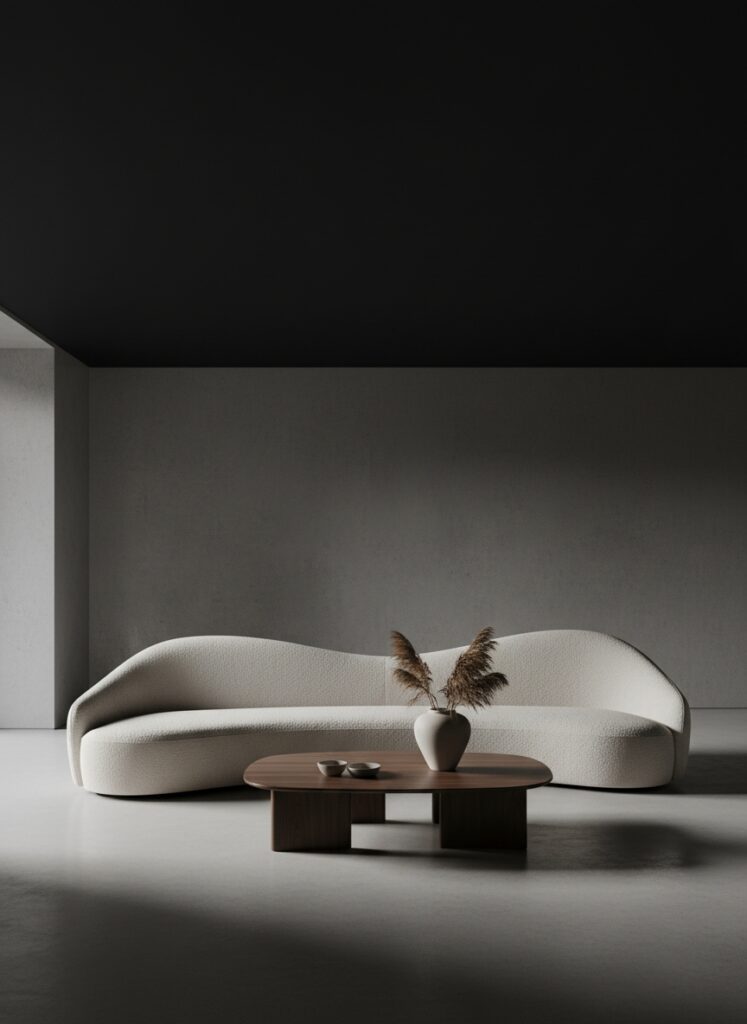
If you are in a small space, utilizing floating furniture layouts keeps the floor visible, which counteracts the heavy ceiling. It’s a balancing act. You compress the top, so you open up the bottom.
Furthermore, consider your materials. Affordable sustainable furniture brands often use natural woods and linens. These warm, textured materials pop incredibly well against a dark backdrop. A pale oak table under a charcoal ceiling? Perfection.
5. Managing Small Spaces and Zoning
Can you do this in a studio? Yes. In fact, it’s one of the best ways to handle studio apartment micro-zoning.
Paint the ceiling dark only over the “bedroom” area of your studio. It visually separates the sleeping zone from the living zone without taking up a single inch of floor space. It creates a psychological “canopy.”
If you have a broken-plan living room layout, where walls are partial or non-existent, carrying a dark ceiling through the whole space acts as the unifier. It ties the chaos together.
The “Oh No, What Have I Done” Mistakes
I have seen people cry over paint colors. It happens. Here is how to avoid the tears.
The “Squashed” Room
This happens when you paint the ceiling dark but leave the walls stark, bright white with a sharp line at the top. This is the “lid on a box” effect. It visually lowers the ceiling height immediately.
The Fix: Bring the ceiling color down the wall by about 4-6 inches (a technique often used in fake entryway ideas to define space). Or, paint the walls a mid-tone gray or beige. You need a bridge between the dark ceiling and the rest of the room. High contrast at the ceiling line is the enemy of height.
The “Black Hole” Effect
You painted the ceiling black, and now your beautiful walnut bookshelves have disappeared into the gloom.
The Fix: You forgot about vertical contrast. You need vertical storage solutions that are lighter in color, or you need to back-light your shelving. Also, use mirrors. A strategically placed mirror reflects the lighter parts of the room and bounces that light around, breaking up the heavy blocks of color.
The Texture Trap
You ignored my advice about matte paint. You used an eggshell finish because it was “washable.” Now, every time you turn on the lamp, you see the tape lines from when the house was built in 1990.
The Fix: There is no fix except repainting. Or, you can lean into the chaos and cover a wall with biophilic living wall elements. The plants will distract the eye. But honestly? Just buy the matte paint. If you are worried about cleaning the ceiling—how often are you actually scrubbing your ceiling? Exactly.
Color Drenching vs. The Statement Ceiling
There is a trend right now called “Color Drenching,” where the trim, walls, and ceiling are all the same color. This is moody maximalism at its peak.
If you have a small apartment, this is actually a power move. When the eye cannot find where the wall ends and the ceiling begins, the room feels larger, not smaller. It feels like a womb.
However, if you aren’t ready to commit to a full drench, painting only the ceiling works best in rooms where you want intimacy. A bedroom. A media room. A dining room.
Don’t do it in a kid’s playroom where Legos are everywhere. You need light to see the Legos so you don’t step on them.
Final Thoughts
The white ceiling is a default setting, not a design rule. It is the generic screensaver of home decor.
Painting your ceiling dark is risky. It takes three coats. It makes your neck hurt. Your mother-in-law will probably hate it and ask why you live in a cave. But when you sit down in that room at night, turn on a warm lamp, and feel the space wrap around you, you’ll get it.
Be brave with the paint roller; it’s the cheapest renovation you can do that actually changes how a room feels.