
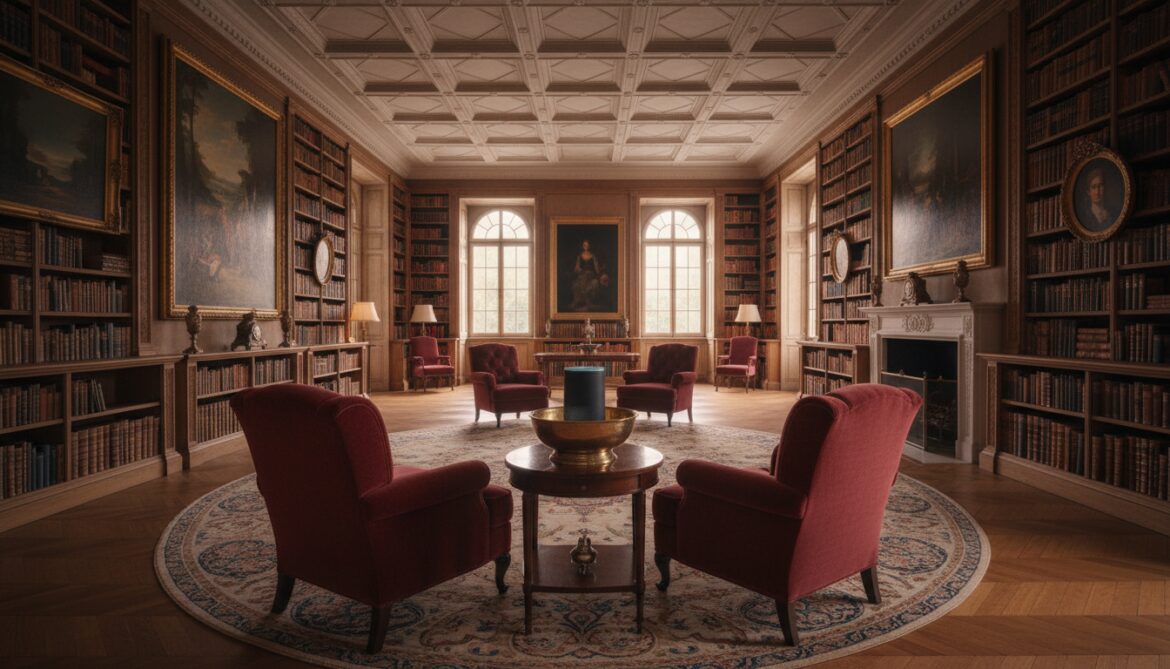
I have a confession to make, and it might get me kicked out of the purist design circles.
I love my smart home devices.
I know, I know. I spend my days hunting for 19th-century oil paintings and preaching about the soul of hand-scraped wood floors. I live for the creak of a vintage leather armchair. Yet, the moment I walk through the door with an armful of groceries, I am barking commands at a plastic cylinder to turn on the lights and play jazz.
But here is the problem that drove me absolutely insane for years: The Aesthetics of Convenience.
Tech companies design for the future. We design for the past, or at least a cozy, timeless version of the present. These two philosophies are at war. A glossy white orb does not look “minimalist” sitting on a chipped, rustic farm table; it looks like a pimple. It breaks the immersion. It screams, “I am a computer!” in a room that is whispering, “I am a sanctuary.”
For a long time, I just hid them in drawers, which defeats the purpose of voice activation. Then I tried leaving them out, which ruined my vignettes.
There has to be a middle ground. You don’t have to choose between living like a Luddite and living in an Apple store.
The Psychology of Visual Noise
Why does seeing a router or a smart hub bother us so much?
It’s about anxiety.
We unconsciously scan rooms for threats and discord. When you are trying to cultivate a space designed for decompression—perhaps leaning into blue interior design principles for anxiety relief—a blinking green LED or a stark black wire creates a micro-stressor. It’s visual clutter. It reminds you of emails. It reminds you of updates. It reminds you of the grid.
If you are a fan of moody maximalism, especially in a small apartment where every square inch counts, that piece of plastic is even more offensive. It fights with your textures. It reflects light when everything else absorbs it.
The goal isn’t just to hide the object; it’s to maintain the emotional integrity of the room.
Strategy 1: The Camouflage Paint Job
Let’s start with the most aggressive tactic. Paint it.
I am not joking. I have taken a paintbrush to many a Google Home Mini.
If you have embraced the dark ceiling paint color trends, you have a massive advantage here. Mounting a smart speaker or a projector high up on a wall that is painted in a deep charcoal or midnight blue renders the device invisible—if you match the device to the paint.
Most tech comes in white or black. Neither is usually the right shade.
White is too cool, black is too stark. If your room features a lot of earth tones—perhaps you are riding the terracotta and sage green interior design wave—a stark black puck looks like a void in space.
Here is the trick: You cannot paint the speaker mesh directly with thick latex paint or you will ruin the sound. You have to be surgical. Paint the plastic casing to match your wall. For the mesh, use a fabric dye marker or a very light dusting of spray paint specifically designed for fabrics.

If you are strictly renting and terrified of losing your security deposit, look into skins. There are companies now making “toast” covers or wood-grain decals. They aren’t perfect, but a wood-grain Echo Dot sitting on a walnut shelf is 90% less offensive than a plastic one.
Strategy 2: The Texture Trojan Horse
This is my favorite method because it actually improves the room’s tactility.
Tech is smooth. Vintage decor is rough, nubby, and imperfect. To blend the two, you need to smother the tech in texture.
I rely heavily on the mastering of texture in monochromatic interior design for this. If you have a white room, a white speaker is still visible because the texture is wrong. It reflects light differently than linen or wool.
The Basket Trick: Find a shallow, woven basket or a vintage crate. Place the smart speaker inside. If the basket has a loose weave, the sound travels right through. If it’s tight, turn the basket on its side and tuck it into a bookshelf. Now it’s just a texture element.
The Book Stack: I have a hollowed-out stack of vintage encyclopedias in my living room. I didn’t ruin good books; I bought already damaged ones from a thrift store. The smart hub sits inside the hollow cavity. The spine of the book facing the room is perforated with tiny holes I drilled myself. You literally cannot see them unless you are six inches away.

This works exceptionally well if you are utilizing vertical storage secrets to maximize wall space. A bookshelf is a dense visual environment. The eye skips over details. If you nestle a device between a trailing pothos plant and a stack of magazines, it disappears.
Speaking of plants, biophilic design is your best friend here. A living wall or a dense cluster of ferns is the ultimate acoustic screen. Leaves break up sound waves (which is good for acoustics) and they break up sightlines. Tucking a subwoofer behind a large Monstera plant in a curved furniture layout creates a soft, organic barrier that rigid tech boxes can’t penetrate.
Strategy 3: Lighting as Distraction
Sometimes you can’t hide the device, so you have to blind the eye to it.
We need to talk about warm vs cool white lightbulb temperature.
Smart speakers often have their own lights—the spinning blue ring of Alexa or the four dots of Google. These are almost always “cool” light (around 4000K-5000K). If your room is lit by vintage incandescent bulbs or warm LEDs (2700K), that blue light cuts through the room like a laser.
Turn off the status lights in the device settings. That is step one.
Step two is using the light source itself as the tech. Instead of having a smart speaker on the table, use smart bulbs in vintage lamps. I have a 1960s ceramic lamp with a heavy linen shade. Inside is a high-tech bulb that connects to my Wi-Fi.
The tech is hidden inside the vintage aesthetic.
If you are a renter, this is key. Renter-friendly lighting hacks often rely on plug-in sconces or floor lamps. By making the bulb the “brain,” you eliminate the need for the separate hub on the counter. The switch on the wall stays on, but the vintage lamp becomes the voice-activated interface.
Strategy 4: The Layout Shell Game
Where you put the furniture determines where the eye settles.
If you follow the 60-30-10 rule for color balance, your tech should ideally fall into the 10% accent category or disappear into the 60% base color. Never let it be the 30% secondary color. It draws too much attention.
In a broken plan living room layout, you often have floating shelves or room dividers. These are prime real estate for hiding tech because you can access the back of the unit for cabling.
One of my go-to moves for clients in studio apartments, specifically when we are working on micro-zoning layouts, is to create a “tech drop zone” that is visually blocked from the bed.
For example, use a fake entryway concept. You might not have a real foyer, but you can position a console table behind a sofa or near the door. Use a tall vase or a piece of art to block the line of sight from the main living area to the smart display sitting on that console. It listens to you from the entryway, but you don’t have to look at it while you’re watching a movie.
This also solves the cord issue. If you are using floating furniture in a small living room, cords trailing across the floor are a death sentence for the vibe. Run the power cord down the leg of the console table, secure it with zip ties, and tuck it under a rug.
Where People Go Wrong (The Mistakes)
I see people try to hide their tech and end up making it worse. Avoid these traps.
1. The “Soundproof” Box I once saw a client hide their Sonos speaker inside a solid wood cabinet with glass doors. They wondered why the music sounded muffled and why the voice assistant never heard them. The Fix: You need acoustically transparent materials. Speaker cloth is the gold standard, but loose-weave burlap, linen, or rattan works. Glass, wood, and acrylic block sound. If you are hiding a subwoofer, low frequencies can travel through solids better, but high-frequency tweeters (vocals) need air.
2. The Mirror Reflection You place the device behind a vase, thinking it’s hidden. But you have a large mirror on the opposite wall to make the small room look bigger. The Fix: Sit on your couch. Look at the mirror. Can you see the back of the ugly plastic speaker reflected in the glass? Mirrors double your space, but they also double your clutter. Check your angles.
3. The Japandi Clash Japandi design is all about intentionality and empty space. If you put a smart speaker on a Japandi shelf, it stands out more because there is nothing else there to distract the eye. The Fix: In minimalist styles, you cannot use the “clutter” camouflage method. You must use the architectural method. Mount the device under the shelf, or behind a structural beam. Or, invest in affordable sustainable furniture brands that offer pieces with built-in cable management and hidden compartments. The furniture must do the heavy lifting because you don’t have enough decor to hide the crimes.
Making It Work
At the end of the day, our homes are machines for living, but they shouldn’t look like machinery.
You want the magic of the music appearing out of thin air. You want the convenience of dimming the lights without getting up. But you also want the romance of your vintage rug and the moody atmosphere of your dark walls.
It takes a little extra work to drill out a book spine or paint a plastic casing, but the result is silence. Visual silence. And that is worth every second of effort.