
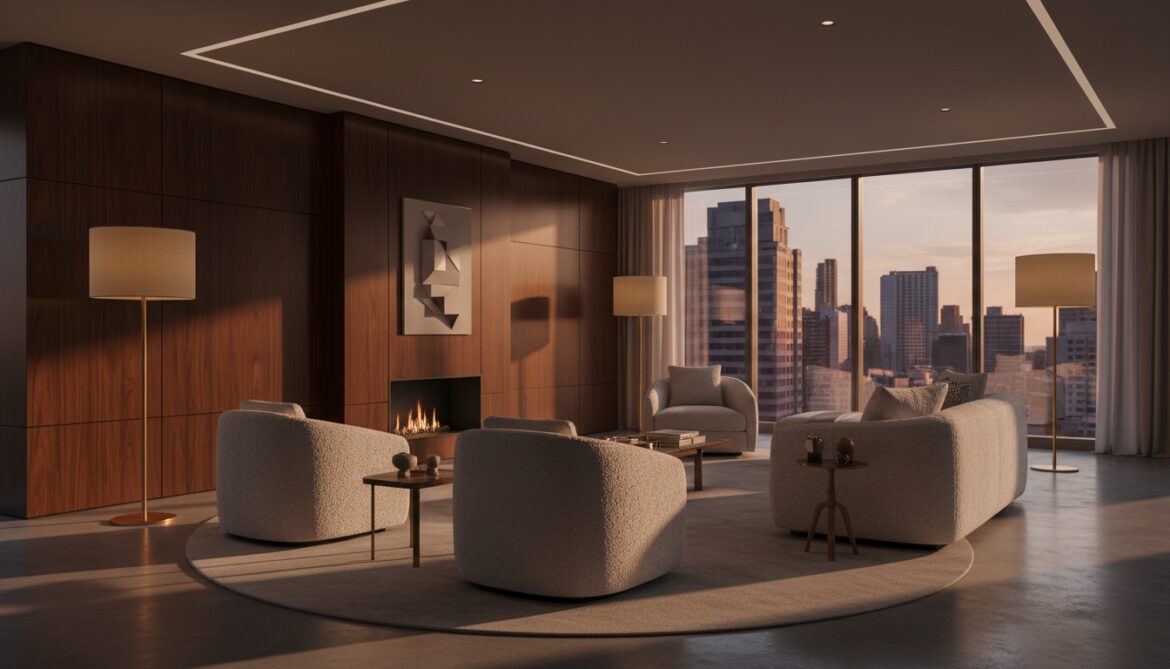
I walked into a dinner party last week, and I immediately wanted to leave.
It wasn’t the food. The host is a lovely person. The problem was the kitchen island pendants. They were blasting 6000K “Daylight” LEDs directly onto a charcuterie board, turning the salami a sickly, gray-ish purple and making everyone’s skin look like they were recovering from a severe flu. It felt like I was eating cheese in a dental surgery.
This happens constantly.
We spend thousands on sofas, rugs, and paint, yet we destroy the entire vibe with a $5 bulb grab-and-go purchase at the hardware store. It drives me absolutely insane.
Lighting isn’t just about seeing where you are walking so you don’t trip over the cat. It is the invisible paint that coats every single surface of your home. Get it wrong, and your expensive renovation looks cheap. Get it right, and a thrifted apartment looks like a boutique hotel.
You have to stop buying bulbs based on wattage. That metric is dead. You need to start caring about temperature.
The Kelvin Scale: Your New Best Friend
Let’s get technical for exactly thirty seconds. Light color is measured in Kelvins (K).
The lower the number, the warmer (yellower) the light. The higher the number, the cooler (bluer) the light.
- 2200K – 2700K: This is the “cozy zone.” Think candlelight, sunsets, and that golden hour glow that makes everyone look attractive.
- 3000K: Soft White. This is the neutral ground. It’s crisp but doesn’t have that sterile blue tint.
- 4000K: Cool White. This is task lighting. It’s bright, clean, and clinical.
- 5000K – 6500K: Daylight. Unless you are performing open-heart surgery or growing hydroponic basil in a closet, do not bring these into your home.
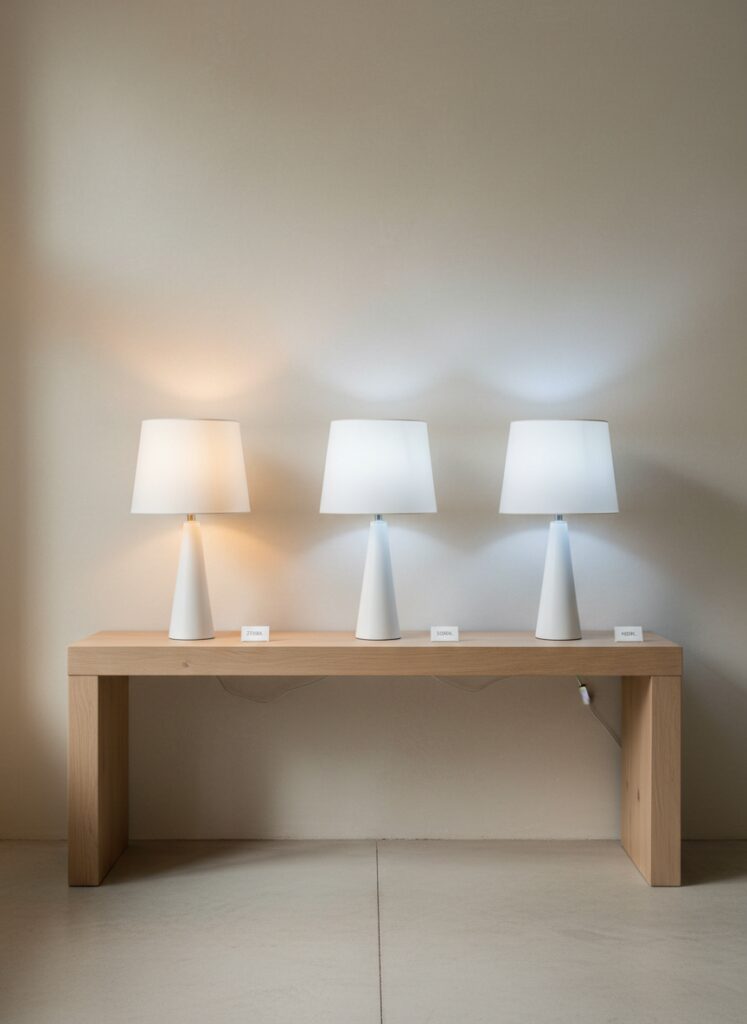
Manufacturers lie to you. They label 5000K bulbs as “Daylight” because it sounds nice. It sounds natural. But real daylight comes from the sky, filtered through the atmosphere. When you put that same intensity inside a drywall box, it doesn’t look like the sun.
It looks like a prison interrogation room.
The Living Room: Banishing the Blue
Your living room is for lounging. It is for unwinding. Why on earth would you want high-alert blue light in here?
If you are embracing the shift toward curved furniture and organic interior design, you are likely dealing with textured fabrics like boucle, wool, or raw linen. Cool light flattens these textures. It washes out the shadows that give those curves their dimension.
To make organic shapes pop, you need warmth.
Stick strictly to 2700K for table lamps and floor lamps. If you have overhead recessed lighting (cans), you can push it to 3000K, but put them on a dimmer. You rarely want your ceiling to be the brightest thing in the room.
If you have a floating furniture layout in a small living room, lighting becomes even more tricky. You have space behind the sofa. Use it. Place a canister uplight on the floor behind the couch with a warm bulb. This creates a silhouette effect that makes the room feel deeper, rather than just brightly lit from above.
The Kitchen: The Great Debate
The kitchen is the hardest room to light because it has a split personality. It is a workspace, but it is also a gathering space.
You need to see the knife when you’re chopping onions (safety first), but you don’t want to feel like you’re in a cafeteria when you’re eating.
The mistake people make is choosing one temperature for the whole room.
Do not do this. Layer it.
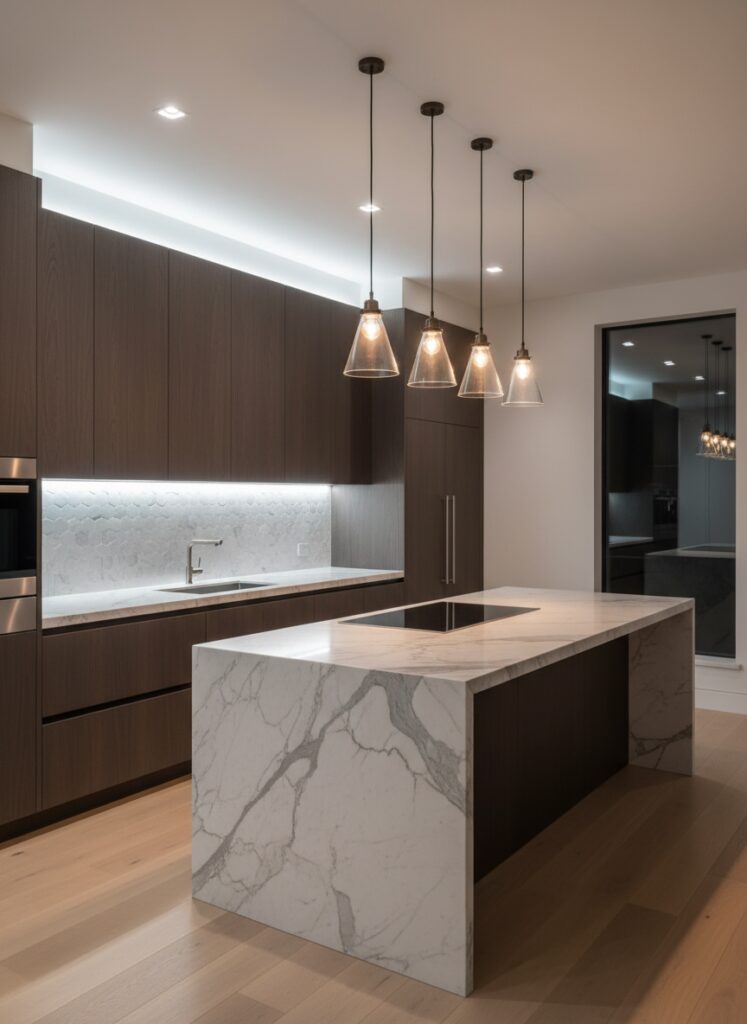
Use 4000K (Cool White) for your under-cabinet task lighting. This helps you see the true color of food and keeps you focused. It’s functional.
However, for your overhead pendants or the main ceiling fixture, drop back down to 3000K. If you go down to 2700K here, white cabinets might start looking a bit yellow or dingy. 3000K keeps the white cabinetry looking crisp without turning the room sterile.
If you are working with a broken plan living room layout, where the kitchen bleeds into the living area but retains some separation, color temperature matching is key. You cannot have a 4000K kitchen right next to a 2700K living room. It creates a jarring visual line that ruins the flow. In these open or semi-open layouts, compromise at 3000K for all general lighting, and save the moody warm light for low-level table lamps.
The Bedroom: Sleep Hygiene is Real
If you have a 5000K bulb in your bedside lamp, you are actively sabotaging your sleep. Blue light suppresses melatonin.
Your bedroom needs to be a cave.
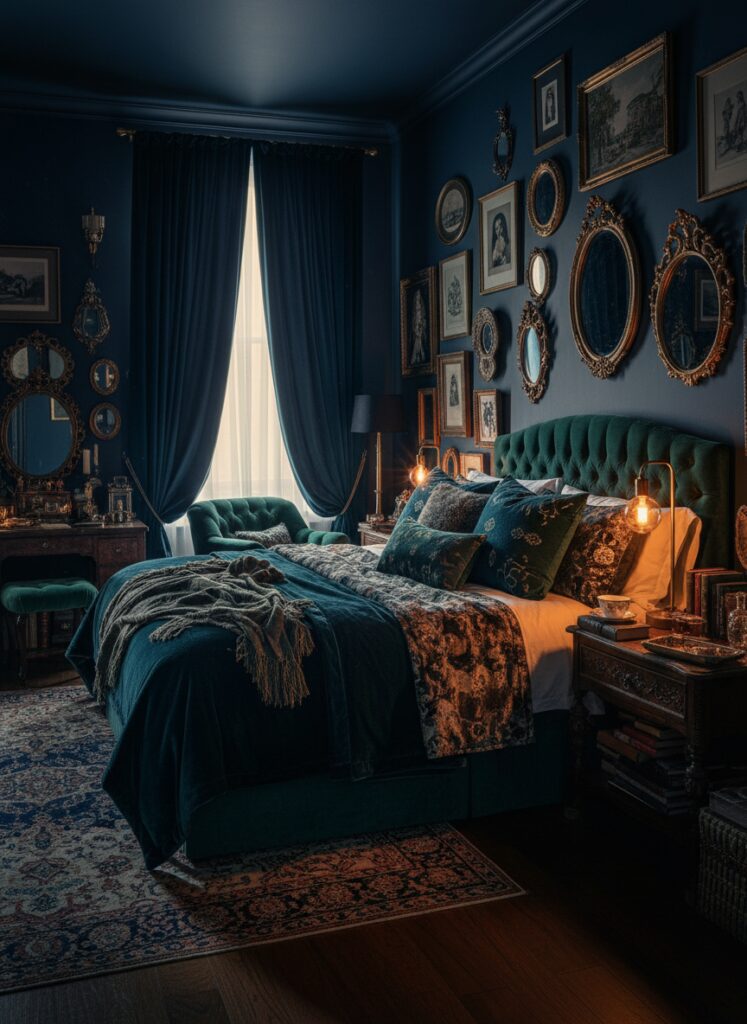
I am seeing a massive resurgence in moody maximalism, especially in small apartments. This aesthetic creates a cocoon-like feeling with dark walls, velvet drapes, and rich colors. Cool lighting kills this look instantly. Blue light hitting a dark green or burgundy wall turns the paint muddy and brown.
For a moody bedroom, go low. I’m talking 2200K to 2400K. Get vintage-style Edison bulbs (you can buy LED versions so they don’t get hot). The amber glow reinforces the richness of the dark decor.
If you are in a studio apartment trying to micro-zone your layout, light temperature is the best divider you have.
You might not have room for a physical screen. But if your “desk zone” has a focused 4000K task lamp, and your “bed zone” five feet away has a warm 2700K sconce, your brain will register them as two completely different environments. It’s a psychological trick, and it works.
The Bathroom: The Vanity Trap
This is the one room where warm light can betray you.
If you do your makeup in 2700K candle-light, you are going to look orange when you walk outside. If you do it in 6000K, you’ll look ghostly and might over-apply bronzer to compensate.
You need accuracy here.
Aim for 3000K to 3500K around the mirror. This mimics the most flattering time of day outdoors.
Speaking of mirrors, if you are using mirrors to make a small room look bigger, pay attention to what the mirror is reflecting. If your mirror reflects a cool light source into a warm room, you create a confusing visual clash. Position your lighting so the reflection doubles the warmth, not the glare.
The Home Office and Biophilia
Here is where I break my “no blue light” rule.
If you work from home, you need alertness. A 4000K bulb in your desk lamp helps concentration. It signals to your brain that it is time to be productive.
Furthermore, if you are following the biophilic design trends and installing living walls, your plants have opinions too. Most indoor plants struggle to photosynthesize effectively under standard warm household LEDs. They need the blue spectrum.
If you have a grow light or a dedicated plant light, it will likely be cool (often pinkish or stark white). Don’t fight this. Just make sure you turn those specific plant lights off when the work day is done, so your home transitions from “greenhouse office” to “cozy lounge.”
The “Renter Friendly” Lighting Dilemma
Renters often feel stuck with whatever horrible boob-light the landlord installed.
You aren’t stuck. Change the bulbs.
Store the landlord’s bulbs in a shoebox and put them back when you move out. It is the single most effective change you can make. But beyond the ceiling, floor lamps are your savior.
If you are dealing with a dark, windowless corridor and trying to create a fake entryway in your living room, do not rely on a single overhead bulb. It creates cave-like shadows in the corners.
Instead, use a vertical approach. A tall, slender floor lamp with a 2700K bulb creates a pool of light that defines the “entry” space. Use battery-operated sconces if you can’t drill holes. There are plenty of renter-friendly lighting hacks that allow you to bypass hardwiring entirely.
Three Ways You Are Probably Messing This Up
Even with the right bulbs, things go wrong. Here are the pitfalls I see in 90% of homes.
1. The “Zebra” Effect
You bought a warm white bulb for the lamp, but the ceiling lights are cool white. Now your room looks like a zebra.
Mixing color temperatures in a single room creates visual chaos. It makes the space feel cluttered, even if it’s tidy. Your eye doesn’t know how to adjust. Pick a lane. If the overheads are 3000K, the lamps should be 2700K or 3000K. Never mix a 2700K with a 5000K. It looks like a mistake, because it is one.
2. Ignoring CRI (Color Rendering Index)
Two bulbs can both be “2700K” but look completely different. Why? CRI.
CRI measures how accurately a light reveals color compared to natural sunlight. A low CRI bulb (under 80) makes colors look dull and gray. A high CRI bulb (90+) makes colors pop.
If you have invested in affordable sustainable furniture brands, you want that recycled wood grain or natural cotton to look expensive. A cheap, low-CRI bulb will make even a $2,000 table look like plastic laminate. Always check the box for “CRI 90” or higher. It costs a dollar more and makes a massive difference.
3. Ignoring Verticality
You have lamps on tables. You have lights on the ceiling. But what about the middle?
Shadows gather in corners and on shelves. If you have open shelving, dark corners shrink the room.
This is especially important if you are utilizing vertical storage secrets to maximize wall space. If you build shelves up to the ceiling but don’t light them, they just loom over you. Add LED strip lighting (warm white, always) to the undersides of shelves. It adds depth and highlights your decor, making the storage feel architectural rather than utilitarian.

A Note on Dimmers
If you take nothing else from this rant, install dimmer switches.
If you rent, buy smart bulbs that dim via your phone. Light needs to change with the time of day. 3000K is great at 4 PM on a winter Tuesday. It is too bright at 10 PM on a Friday.
The ability to control intensity is just as important as the color. A 2200K bulb at 100% brightness is still aggressive. A 3000K bulb dimmed to 20% can actually feel quite cozy.
Fix Your Lights
Look, design is subjective. You might love a bright blue room.
But biologically, humans are wired to respond to the sun. Bright and blue means “wake up and hunt.” Warm and soft means “rest and digest.”
If your home feels anxious, or if you just can’t seem to relax in your living room despite the comfy chair, look at your lightbulbs. The solution isn’t always a new coat of paint. Sometimes, it’s just changing the temperature.
Go check your lamps. Right now. You can thank me later.