
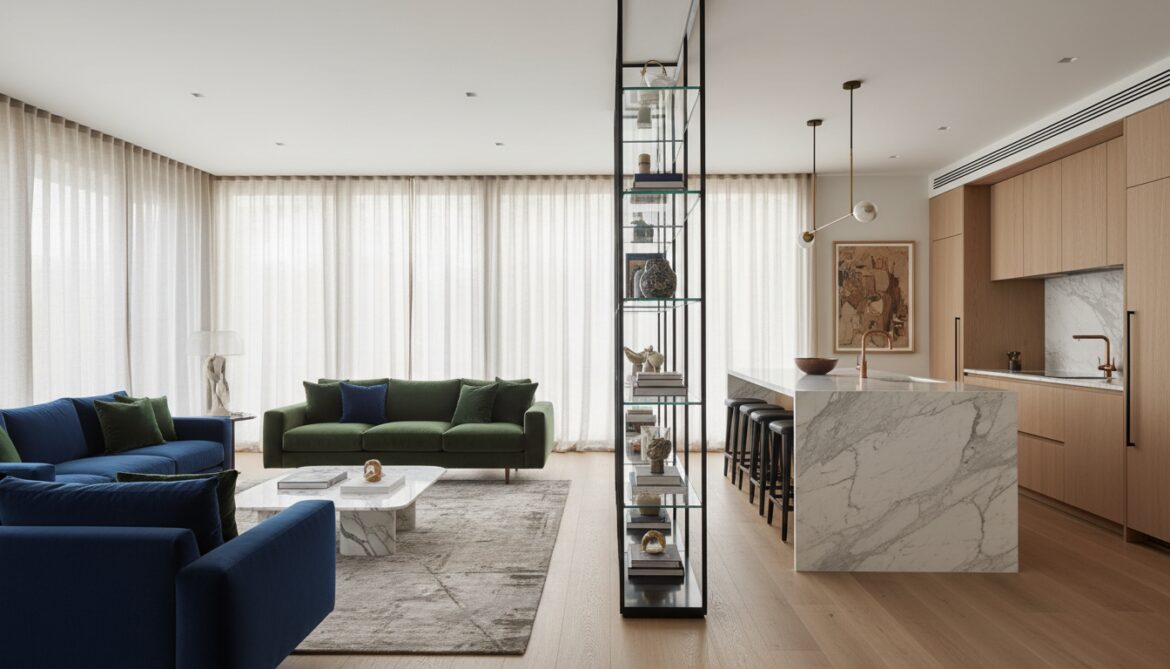
I remember the exact moment I turned on the “Open Concept.”
It was around 2012, and I was watching a couple on TV take a sledgehammer to a perfectly good Victorian dining room wall. They were cheering. The dust was flying, settling into lungs and floorboards alike, and the host promised them a life of “togetherness.”
For a decade, we bought it. We knocked down partitions until our homes looked like aircraft hangars with better throw pillows.
But here is the ugly truth nobody mentioned while the drywall was crumbling: living in a warehouse is loud.
It smells like last night’s salmon every time you sit on the sofa.
It means your Zoom call is the background track to your partner’s blender smoothie session. The lack of walls didn’t bring us together; it just stripped us of the one thing we actually need to maintain sanity, which is the ability to hide.
The pendulum has swung back. Violently.
We are tired of seeing the dirty dishes from the front door, and we are done with the acoustic chaos of a single, echoing box.
Enter “Broken Plan” living.
What is Broken Plan, Anyway?
Don’t panic. I am not suggesting we go back to the dark, claustrophobic corridors of the 1920s where every room felt like a solitary confinement cell.
Broken Plan is the middle child. It is the smart compromise.
It keeps the light and the sightlines of an open layout but introduces physical and visual barriers to create distinct “zones.” It recognizes that while we want to see our family, we might not want to hear them chewing while we read.
Why is this taking over now? Because our homes have to work harder than they ever did before.
Your living room is now an office, a gym, and a cinema. When you try to do all those things in one amorphous blob of space without boundaries, your brain never switches gears. You feel perpetual, low-grade anxiety because you are everywhere and nowhere at once.
Broken Plan fixes the psychology of the room. It gives your eyes a place to land and your body a specific context for specific tasks.
How to Execute Broken Plan (Without Building Walls)
You do not need a contractor. In fact, if you are renting, you can’t use a contractor, which makes this design philosophy the holy grail for apartment dwellers.
You achieve this look through strategic interference. You are intentionally breaking the line of sight, but gently.
1. The Floating Furniture Rebellion
The biggest crime in open-concept living is “wall-hugging.” People push every single sofa and cabinet against the perimeter, creating a useless dance floor in the center of the room. Stop doing that.
To create a Broken Plan layout, you must embrace floating furniture.
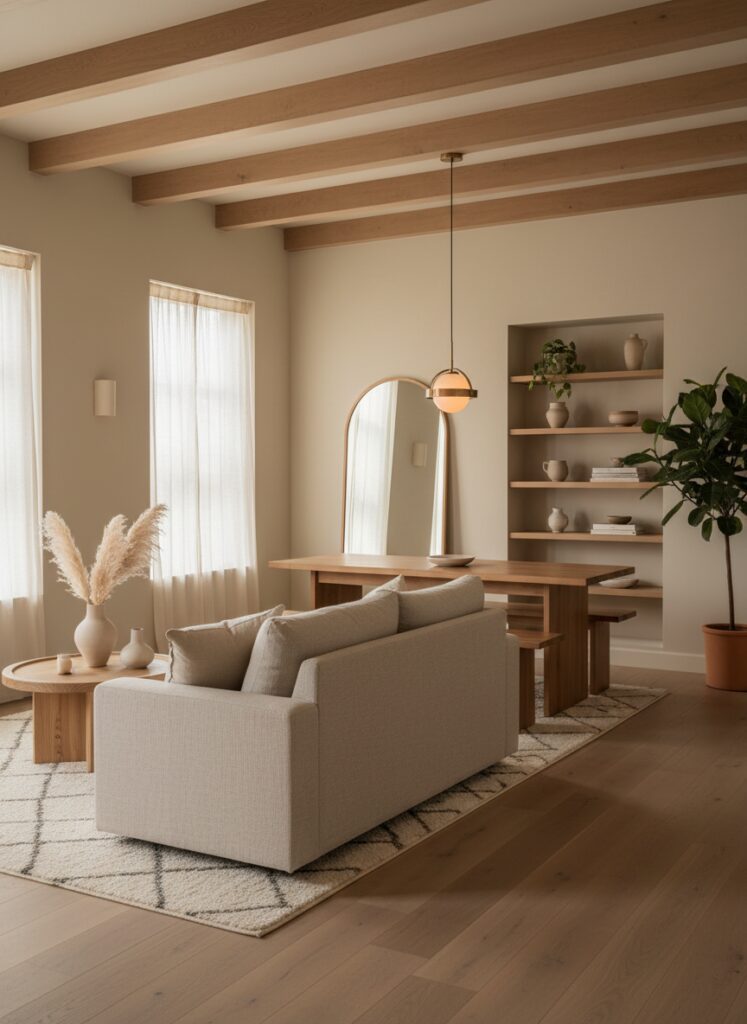
Pull the sofa into the middle of the room. Turn its back to the dining area. Suddenly, the back of that couch acts as a knee-height wall. It says, “The lounging stops here; the eating begins there.”
In smaller spaces, this feels counterintuitive. You worry you are losing square footage.
You aren’t. You are gaining utility.
By anchoring a rug under that floating arrangement, you create a dedicated island. If you are struggling with a studio setup, this is the first step in micro-zoning your life. You physically carve out a bedroom without a door simply by orienting a wardrobe or a sturdy shelving unit at the foot of the bed.
2. The Bookshelf Barrier
This is my favorite trick, and I have used it in at least a dozen client homes this year.
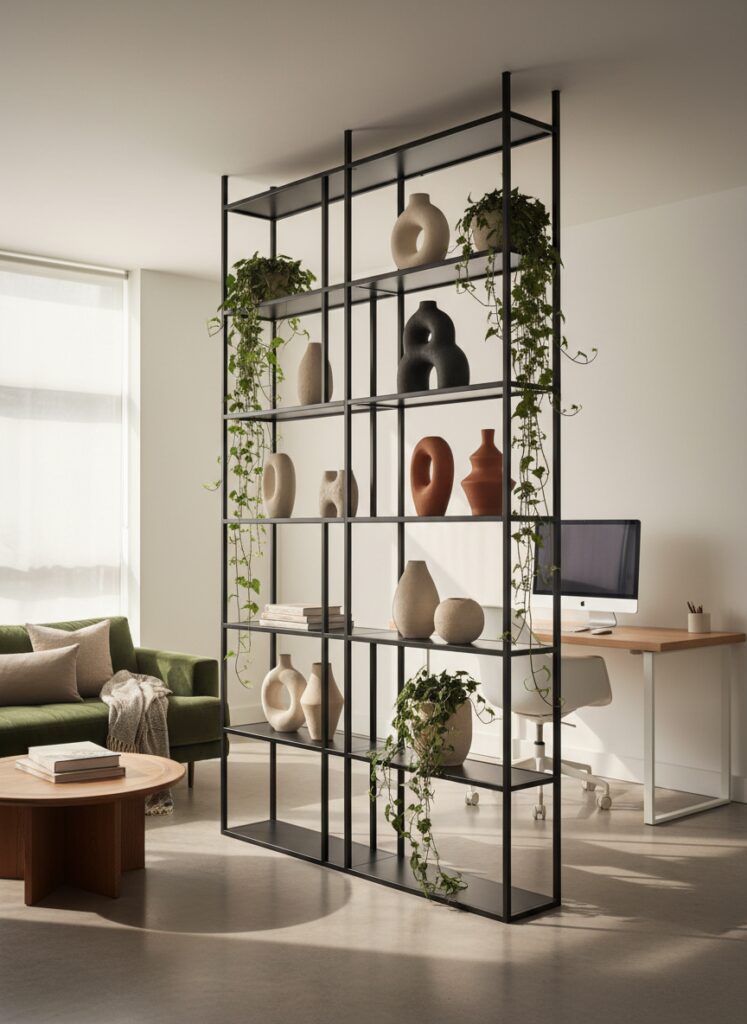
Take a tall, open-back bookshelf—the kind you can see through—and place it perpendicular to the wall. It acts as a screen.
It filters the light rather than blocking it, keeping the space airy, but it clearly demarcates a change in purpose.
On the bottom shelves, use heavy, solid bins for vertical storage. This weighs the unit down visually (and physically—please anchor your furniture) and blocks the view of the clutter on the floor. On the upper shelves, leave gaps. Place a few sculptural objects or trailing vines.
This creates a “peek-a-boo” effect. You can hear if the toddler crashes into the coffee table, but you don’t have to stare at the pile of toys while you are trying to eat dinner.
3. Lighting is a Wall
We tend to think of walls as drywall and timber, but light is just as effective at containment.
In a massive open room with one giant “boob light” on the ceiling, everything is flattened. It’s a cafeteria.
Broken Plan relies on pools of light to define territory.
Turn off the overheads. Use a low-hanging pendant light over the dining table. It casts a cone of illumination that traps the table in its own little world.
Then, use floor lamps and table lamps in the living area. When the kitchen lights are off and the living room lamps are on, the kitchen disappears. It fades into the shadows.
This is a key hack for renters who cannot install dimmers. By controlling where the light falls, you control where the eye goes. You can effectively “delete” a messy workspace from your evening view just by keeping it in the dark.
4. The Green Partition
If you want separation but hate furniture that feels too blocky, look to biology.
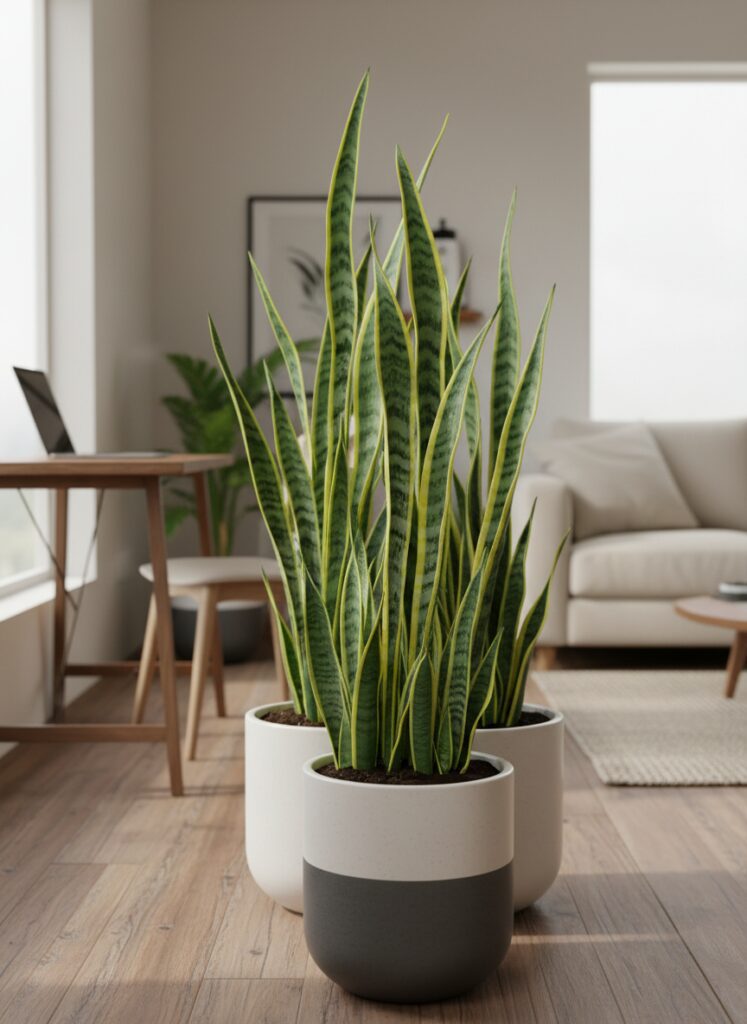
Tall plants are the ultimate soft barrier. A row of snake plants in an elevated planter, or a massive Monstera placed strategically between a desk and a sofa, creates an organic screen.
This taps into biophilic design principles. We are wired to feel calmer around greenery.
Using a “living wall” or a room divider trellis creates a noise buffer. Leaves diffuse sound waves better than flat drywall. If your open plan apartment echoes like a canyon, a dense cluster of plants will perform acoustic therapy on the space.
It creates a veil. You know the other room is there, but the jagged, organic edges of the leaves break up the view, making the space feel more complex and interesting.
5. The Fake Entryway
One of the worst casualties of the open floor plan trend was the foyer. Builders stopped making them. You open the front door and—boom—you are standing in the middle of the living room.
It’s jarring. There is no decompression zone.
Broken Plan demands you build a fake entryway.
You can do this by positioning a console table behind the sofa (if the sofa faces away from the door). Or, use a runner rug that directs traffic specifically from the door to the kitchen, bypassing the lounge area.
You need a visual cue that says, “Wipe your feet, drop your keys, take a breath.”
Without this pause point, the dirt from the street and the stress of the commute bleed instantly into your relaxation zone. Even a small coat rack and a mirror can create this psychological speed bump.
6. Color Blocking and Mood
Paint is the cheapest renovation tool you own.
In a traditional open plan, people paint everything “Builder Beige” or “Safe Gray” to make it flow.
Don’t do that.
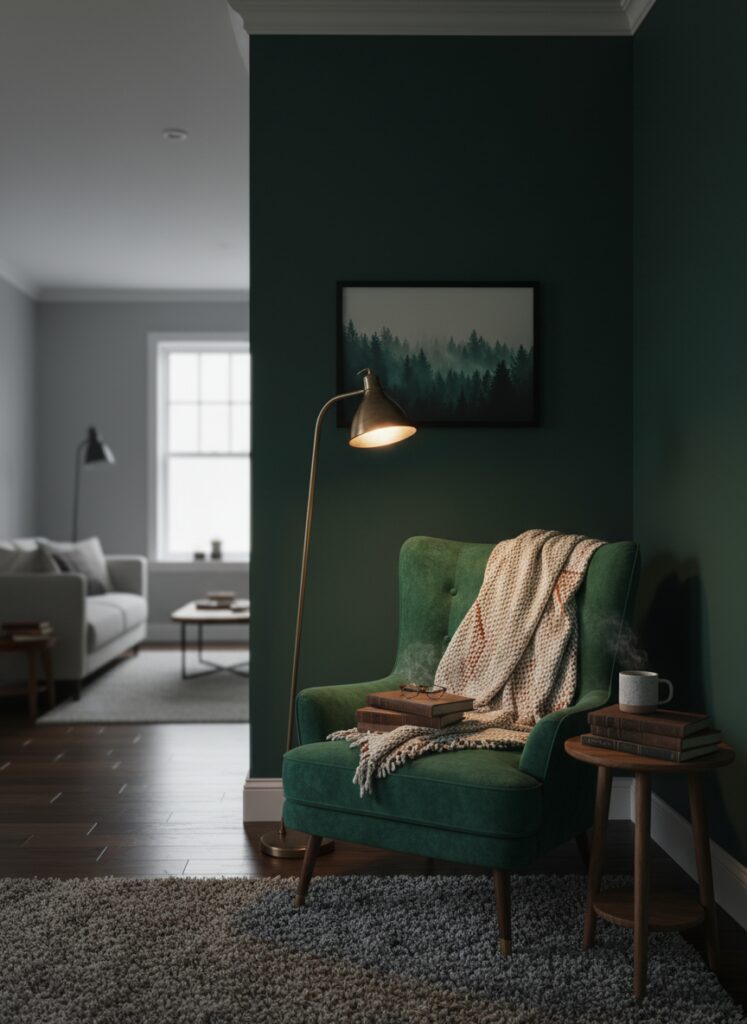
Use color to break the plan. Paint the corner with your reading chair a deep, moody charcoal or forest green. Leave the rest of the room light.
This is where the moody maximalism trend works perfectly with Broken Plan. You can have a dark, dramatic, cozy corner inside a larger, brighter room. The color change acts as a threshold. When you step into the dark zone, the vibe shifts.
It tells your brain: “This is the quiet spot.”
Where People Get It Wrong
You can mess this up. I have seen people turn their living rooms into obstacle courses in the name of “zoning.”
The Traffic Jam: You must respect the flow of traffic. If you put a room divider up, but you have to turn sideways and suck in your gut to squeeze past it to get to the kitchen, you have failed. You need at least 30 to 36 inches of clearance for a walkway. If you don’t have it, don’t force the furniture. Use a rug or lighting to define the zone instead.
The Dungeon Effect: Be careful with solid barriers in small apartments. If you place a solid wardrobe perpendicular to a wall and it blocks the only window in the room, you have created a dungeon.
This is why mirrors are key. If you build a barrier, try to incorporate a mirror on one side of it. It bounces the light around corners and prevents that claustrophobic, boxed-in feeling.
The Clutter Trap: Broken Plan introduces more surfaces. More shelves, more console tables, more dividers.
If you are not careful, these surfaces become magnets for junk. A room divider bookshelf that is stuffed with old mail and tangled cables is not a design feature; it’s an eyesore.
Because you are visually breaking up the space, you are already adding visual complexity. You need to keep the styling on these dividers disciplined. Negative space is your friend. If you fill every inch of your new “zones,” the house won’t feel cozy—it will feel like a hoarding situation.
The New Normal
The era of the endless, echoing hall is over. We realized that while we want to be together, we don’t want to be on top of each other.
We want corners. We want nooks. We want to be able to read a book in a patch of sunlight without watching the dishwasher run.
Broken Plan is just a fancy way of saying “rooms that actually work for humans.” It’s messy, it’s layered, and it requires you to think about how you actually live, not just how the house looks in a wide-angle photo.
So go ahead. Drag that sofa away from the wall. Put a bookshelf in the middle of the floor.
Reclaim your privacy.