
I have a confession to make, and it might get my HGTV membership card revoked.
I am exhausted by “Safe Oatmeal.”
You know the look. That specific shade of greige paint that landlords buy by the barrel. The aesthetic that suggests the person living there is actually a ghost with a severe dairy allergy. For the better part of a decade, we were told that if you live in a small space, you must paint it white. You must own spindly furniture. You must pretend you don’t own “things.”
It’s a lie.
Minimalism in a small apartment doesn’t make it look bigger; it makes it look like a hospital waiting room where you just happen to sleep.
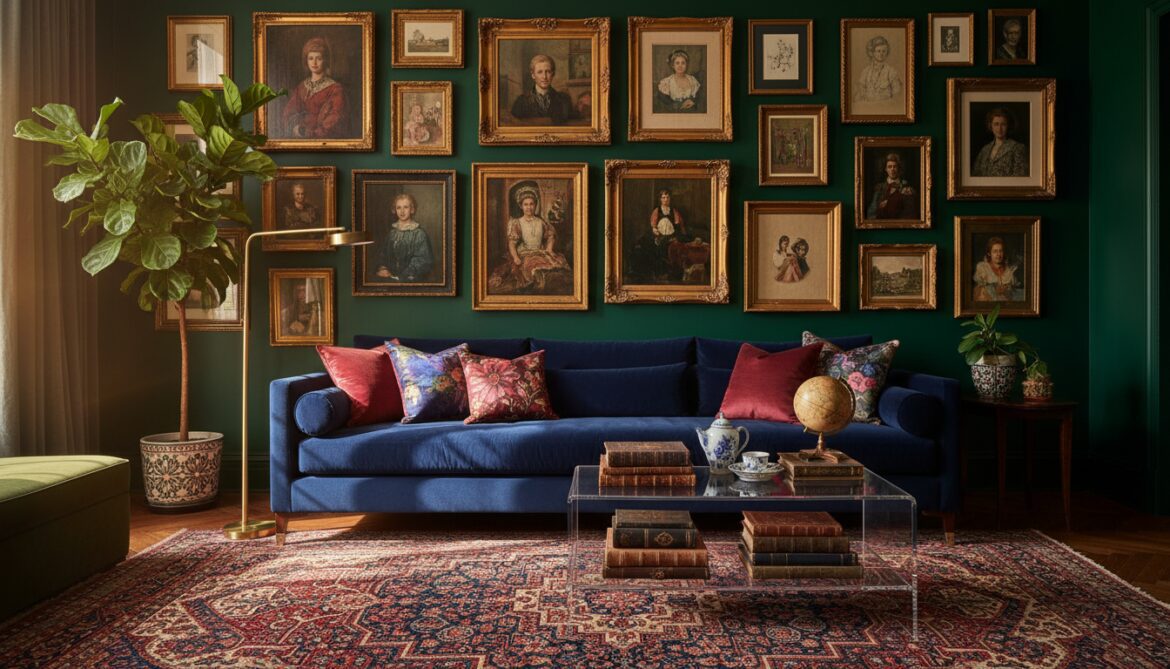
The pendulum is swinging back, and it’s hitting hard. We are entering the era of Moody Maximalism. It is dark. It is cluttered—but in a hot, curated way—and it feels like a hug rather than a sterile lab experiment. But here is the kicker: doing this in 600 square feet (or less) is dangerous.
You walk a fine line between a jewelry box and an episode of Hoarders.
The Philosophy of the Cave
Why does this work?
Conventional wisdom screams that dark colors shrink a room. That is technically true, but emotionally false. When you paint a small room stark white, the corners are defined. You can see exactly where the room ends. It is a box, and you are the rat.
When you drench a room in charcoal, navy, or deep forest green, the corners disappear. Shadows swallow the boundaries. The room doesn’t feel “open,” sure, but it feels infinite. Like space. Or the bottom of the ocean.
Moody Maximalism is about density. It creates an atmosphere so thick you have to wade through it. For renters and small homeowners, this is the escape hatch from the “temporary” feeling of white walls. It says, “I live here, I have a personality, and I am not afraid of dust.”
How to execute the “Vibe” without losing your deposit
You cannot just buy a velvet sofa and call it a day. You have to layer. You have to build the room like a lasagna.
1. The Walls: Paint or Distract
If your landlord lets you paint, go dark. I’m talking about a color that scares your mother. “Railings” by Farrow & Ball or “Salamander” by Benjamin Moore. If you paint the walls, paint the trim too. Painting the trim white against a dark wall outlines the room’s small footprint. Drench it all.
If you cannot paint? You have to attack the vertical plane differently.
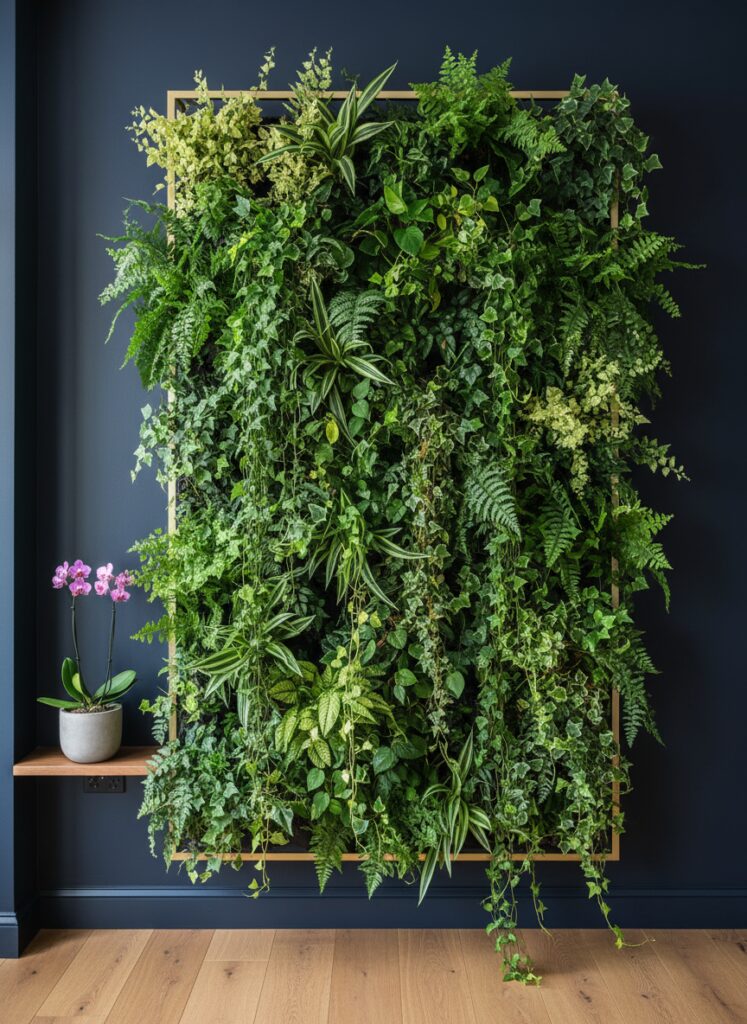
This is where texture saves you. I have seen incredible success with peel-and-stick wallpaper, but that can get pricey. A better, more tactile option is leaning into biophilic design. I’m not talking about a sad pothos on a shelf. I mean living walls.
A vertical garden or a dense cluster of hanging plants acts as a living, breathing wallpaper. It breaks up the “renter white” without risking your security deposit. The texture of foliage absorbs light and sound, creating that “moody” silence we crave. It’s the difference between a room that feels empty and a room that feels organic.
2. The Lighting: Death to the “Big Light”
Never, under any circumstances, turn on the overhead ceiling light. That fixture is for finding lost contact lenses and nothing else.
Moody maximalism dies under harsh glare. It thrives in pools of amber light.
You need at least five sources of light in a small living room. Yes, five. Floor lamps, table lamps, picture lights. If you are renting and can’t wire in sconces, you have to get scrappy with renter-friendly lighting hacks.
Use battery-operated puck lights inside sconces glued to the wall. Use smart bulbs that can dim to 1% brightness. The goal is to light the corners and the middle, creating shadows in between. This high-contrast lighting forces the eye to travel, making the space feel complex rather than just “small.”
3. The Layout: Float or Die
The biggest rookie mistake in small apartments is pushing all the furniture against the walls to “create space” in the middle.
Congratulations, you have created a dance floor for mice.
Pushing furniture to the perimeter highlights the limits of the room. Instead, you need to engage in floating furniture. Pull the sofa twelve inches off the wall. Put a console table behind it. Angle the armchair.
When you float furniture, air circulates around the pieces. It suggests that the room is large enough to accommodate the layout, even if it barely is. It creates flow. It tells the brain, “There is space behind this sofa,” even if that space is just enough for a dust bunny.
4. Zoning: The Psychological Divide
In a studio or open-plan box, maximalism can look like a garage sale explosion if it isn’t corralled. You need zones.
You might think you don’t have space for zones. You are wrong.
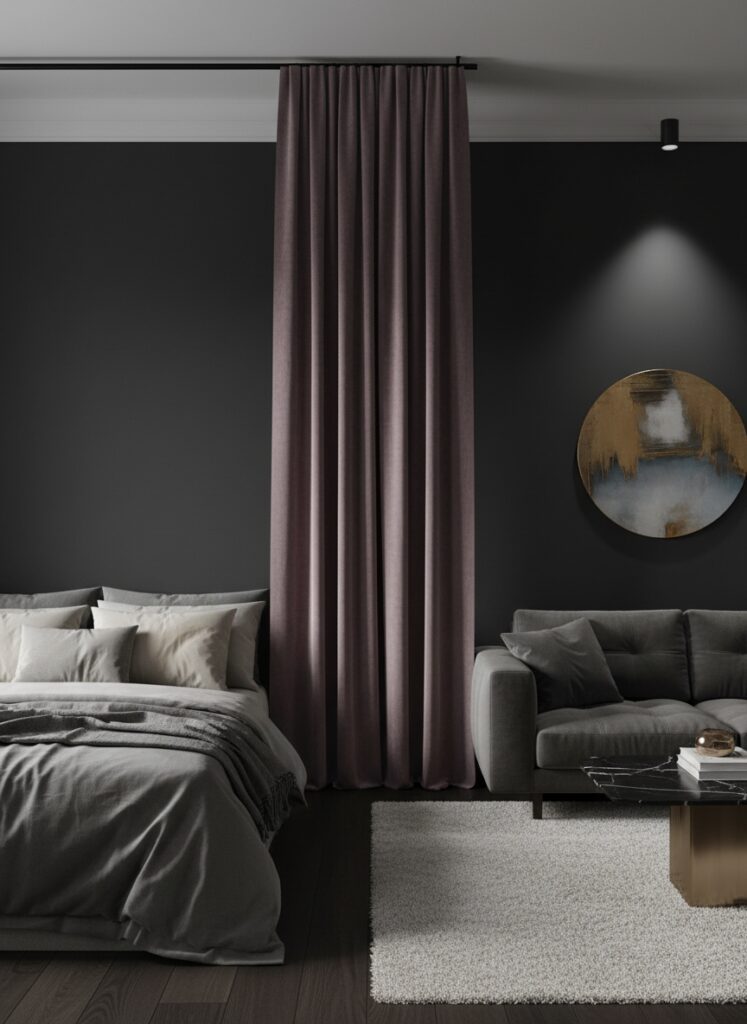
A rug is a zone. A bookshelf turned perpendicular to the wall is a zone. This is the art of studio apartment micro-zoning. You need to visually separate the “sleeping cave” from the “living lounge.”
In a moody aesthetic, you can do this with color blocking (using rugs) or physical barriers. A velvet curtain on a tension rod is a dramatic, theatrical way to hide a bed. It adds softness, absorbs sound, and screams “luxury hotel” rather than “dorm room.”
5. The “Fake” Rooms
Does your front door open directly into your sofa? That’s annoying. It kills the vibe. It makes the whole apartment feel transient.
You need to manufacture a sense of arrival. Even if you have four square feet of clearance, you can implement fake entryway ideas. A narrow console table, a dedicated hook for keys, and a specific piece of art can psychologically separate “outside” from “inside.”
In a maximalist home, this is where you start the story. A dark, small rug and a weird, vintage mirror right by the door set the tone immediately.
6. Verticality and the “Stuff”
Maximalism requires “stuff.” Books, ceramics, weird brass animals, records. But where does it go?
If you go wide, you lose floor space. You must go up.
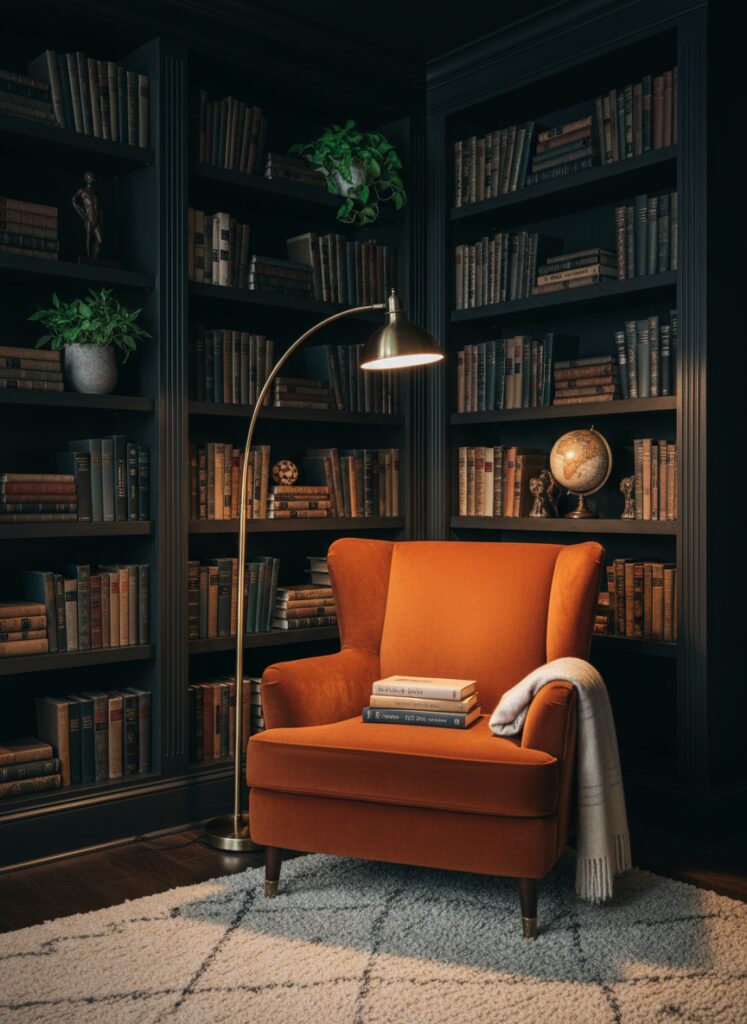
Mastering vertical storage secrets is the only way to keep maximalism from becoming clutter. Floor-to-ceiling shelving is your best friend. Even if you use cheap IKEA Billy bookcases, paint them the same color as the wall (or cover them in contact paper) to make them look built-in.
Use the space above the door frame. Use the space above the kitchen cabinets. In a moody room, books act as insulation. Walls of books feel cozy; piles of books on the floor feel messy. There is a difference.
7. Mirrors: The Smoke and Mirrors Trick
Because you are using dark colors and heavy textures, you risk the room feeling like a coffin. You need to bounce what little light you have.
You need mirrors.
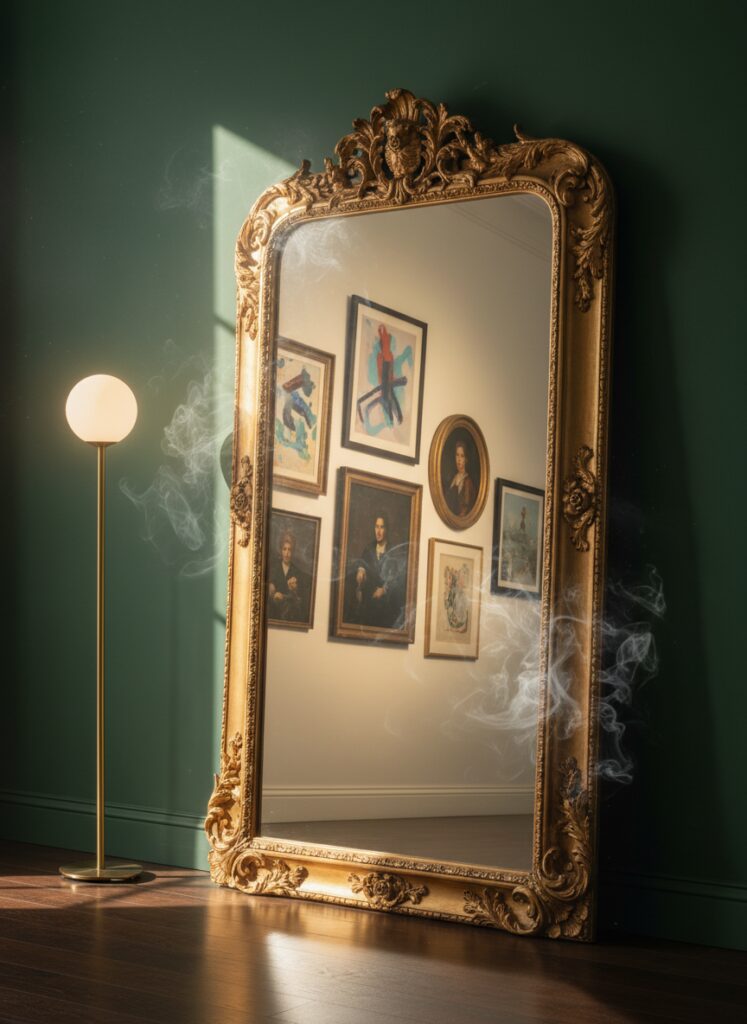
But not just a mirror screwed into the back of a door. You need large, intentional glass. A massive floor mirror leaning against a dark wall doubles the visual depth. It reflects the gallery wall opposite it. It reflects the “pools of light” you created with your lamps.
Ideally, place a mirror opposite a window. It punches a hole in the “cave” wall and brings the sky inside, contrasting beautifully with your dark paint.
Where People Screw This Up
I see the same three mistakes over and over again. It pains me.
1. The “Theme Park” Trap Moody Maximalism is not a costume. Do not buy everything from the “Gothic Industrial” section of a big-box store. If everything matches, it looks cheap. The charm comes from friction. You need a sleek, modern acrylic table next to a battered leather armchair. You need a crusty oil painting next to a neon sign. If you buy a “set” of anything, you have failed. The room should look like it evolved over 20 years, not delivered in 20 Amazon boxes on a single Tuesday.
2. Ignoring Texture If you have dark walls, a dark sofa, and a dark rug, and they are all flat cotton or polyester, your apartment will look like a black hole. You need light-catching fabrics. Velvet. Silk. Leather. Brass. Glass. Texture provides the contrast that color usually provides in a bright room. Without texture, a dark room falls flat. It feels muddy. You need the shimmer of a brass lamp base to cut through the matte black wall.
3. The Scale Problem People in small apartments buy small furniture. “Apartment-sized” sofas are usually uncomfortable and look dinky. A room filled with six tiny pieces of furniture looks more cluttered than a room with two huge pieces. Buy the biggest rug that fits. Buy a deep sofa. One large statement piece anchors the room. A hundred tiny tchotchkes without a large anchor just looks like a flea market.
The Reality Check
Living this way takes work. Dust shows up on dark surfaces immediately. You will be dusting more than you ever have in your life. Maximalism requires curation. You can’t just put everything you own on display. You have to edit. You have to move things around until they “click.”
But the payoff? You get a home that feels like a fortress. When you close the door on the chaotic, bright, noisy world, you are stepping into a cocoon of your own making. It is quiet. It is interesting. It tells your story.
Beige is safe. Beige is easy. But nobody ever walked into a beige apartment and said, “Wow, I want to know the person who lives here.”
Go dark. Buy the weird lamp. Make it moody. Just don’t blame me when you have to buy a better feather duster.