
I murdered a Fiddle Leaf Fig in 2015.
It was a slow, tragic death. I bought into the hype, placed it in a corner that I thought looked nice, and watched it turn into a brown, crispy skeleton over the course of three months.
For years, that was the standard for “bringing the outdoors in.” We bought temperamental trees, shoved them in expensive pots, and prayed they wouldn’t die while taking up precious square footage.
But the shift happening right now is aggressive.
We are done with floor clutter. We are done with “plant corners” that require you to move six pots just to vacuum the rug.
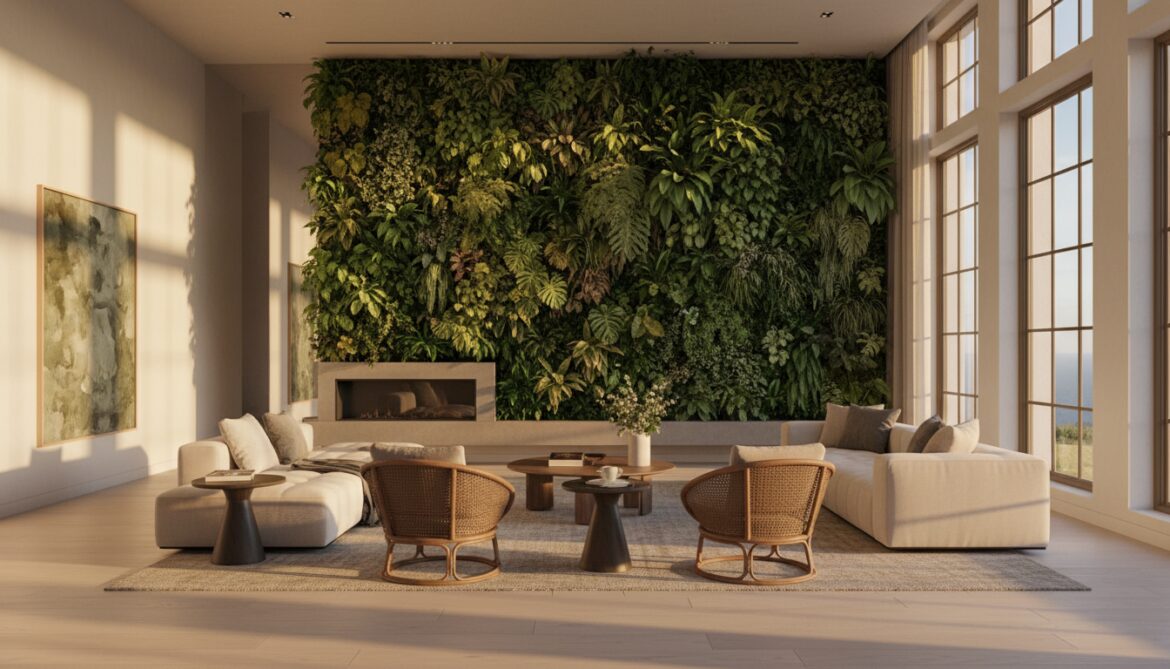
Welcome to Biophilic Design 2.0. The trend for 2026 isn’t about having a plant; it’s about the architecture of the plant. Specifically, living walls.
I used to think green walls were exclusively for tech startup lobbies or high-end salad chains. They felt sterile, corporate, or impossibly expensive to maintain.
I was wrong.
The vertical garden is moving into the living room, and quite frankly, it’s the only design choice that makes sense for the modern, space-starved home.
The Problem with “Pots on the Floor”
Why is this shifting now?
Because our floor plans are shrinking, yet our desire for calmness is expanding. It is a paradox.
When you crowd your floor with ceramics and terracotta, you visually shrink the room. You interrupt the flow.
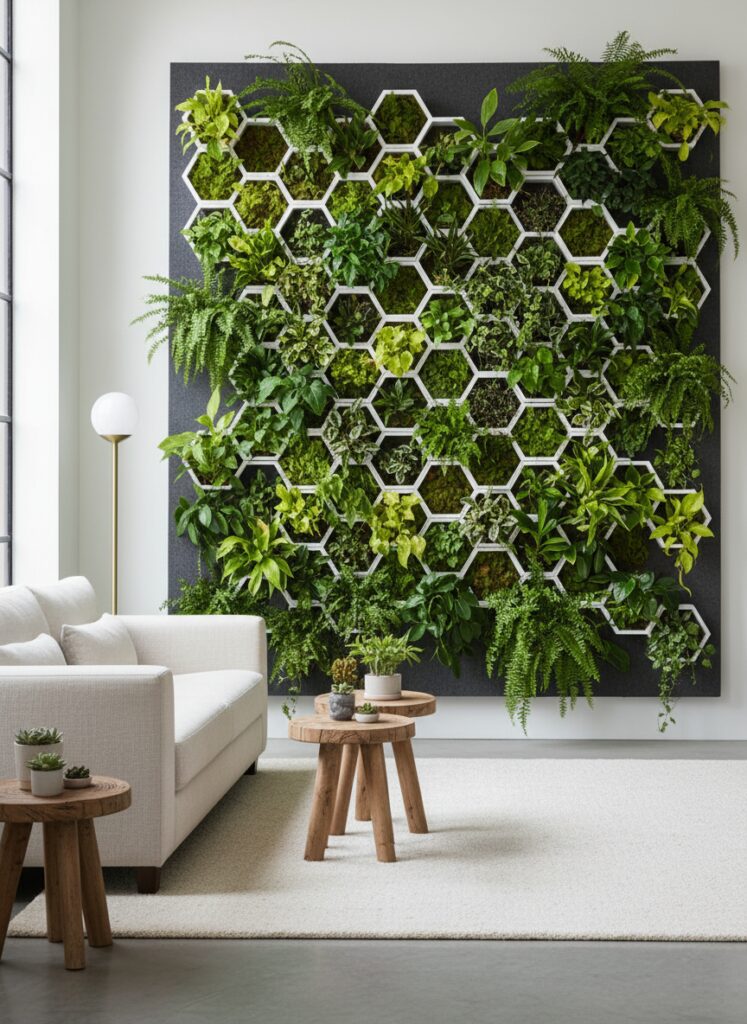
Biophilic Design 2.0 is structural. It treats foliage as a building material rather than a decoration.
Think about wallpaper. Now imagine that wallpaper breathes, eats carbon dioxide, and dampens the acoustic echo of your Zoom calls. That is the new standard.
It’s messy if you do it wrong (and I will tell you exactly how to avoid the mold issues later), but when you get it right, it changes the physics of a room.
Verticality is the New Luxury
Let’s get into the mechanics of why this works, specifically for those of you trying to maximize perception of space.
When you lift vegetation off the ground, you expose the floorboards.
I have preached this for years regarding furniture layouts. The more floor you see, the larger the room feels.
By migrating your greenery to a vertical plane, you clear the runway for floating furniture arrangements. You can center a loveseat or angle an armchair without backing it into a jungle of pots.
This is fundamentally about reclaiming square footage.
A living wall draws the eye upward immediately. It forces a vertical scan of the room, which tricks the brain into perceiving higher ceilings.
If you are struggling with a boxy room, sticking a massive shelving unit against the wall often makes it feel heavier. But a wall of pothos? It adds depth without weight.
How to Build It (Without Ruining Your Drywall)
You might be thinking, “I rent. I can’t drill an irrigation system into my studs.”
Relax. You don’t need a plumber.
The 2026 approach to living walls is modular and low-stakes. Here is how you execute this without losing your security deposit.
1. The Woolly Pocket System
This is my favorite method for beginners.
These are felt pockets effectively. You mount them using standard drywall anchors. The felt breathes, preventing root rot (the silent killer of all houseplants), but the back is lined with plastic to protect your paint.
You can stack these. Start with one row. If you keep them alive, add another row below it.
Over time, the plants grow out and cover the felt entirely. It looks like the plants are bursting directly out of the architecture.
2. The Wire Grid Hack
Go to the hardware store. Buy a simple black wire grid (gridwall).
Lean it or mount it.
Use S-hooks to hang small, lightweight pots. This is technically vertical storage, just applied to biology.
The beauty here is modularity. If one plant gets ugly or dies (it happens), you just unhook it and swap it. You aren’t committed to a massive ecosystem.
3. The Tension Rod Trellis
For the renters who are terrified of drills: tension rods are your best friend.
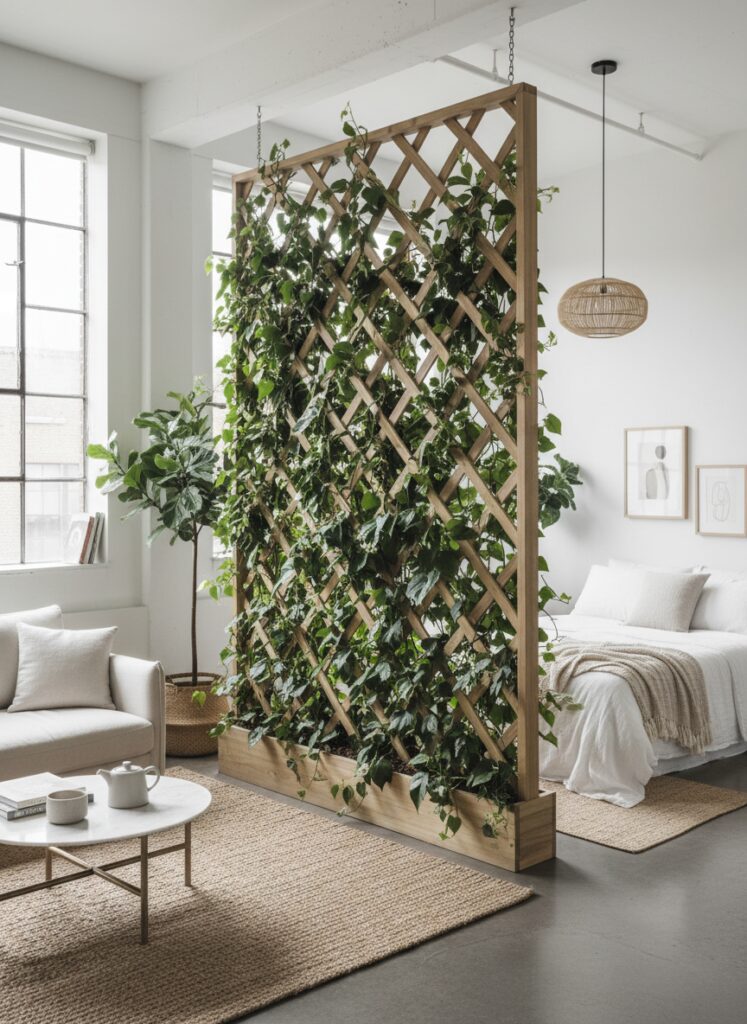
Set up a heavy-duty tension rod system floor-to-ceiling. Zip-tie a trellis or mesh between them.
Place a long planter box at the bottom and let vining plants (Golden Pothos or Heartleaf Philodendron) climb up.
This acts as a semi-transparent green screen. It is phenomenal for micro-zoning a studio apartment. You physically separate your sleeping area from your living area without blocking the light.
Lighting: The Make or Break Factor
This is where 90% of people fail.
They build a beautiful green wall in a dark hallway and wonder why it looks like a funeral home two weeks later.
Plants need light. It is a biological non-negotiable.
However, standard “grow lights” are hideous. They emit a purple, blurple, or harsh white clinical glare that ruins the cozy vibe of a home.
Do not buy industrial grow lights.
Instead, look for full-spectrum LED bulbs that fit into standard fixtures. You want a warm white color temperature (around 3000K to 3500K).
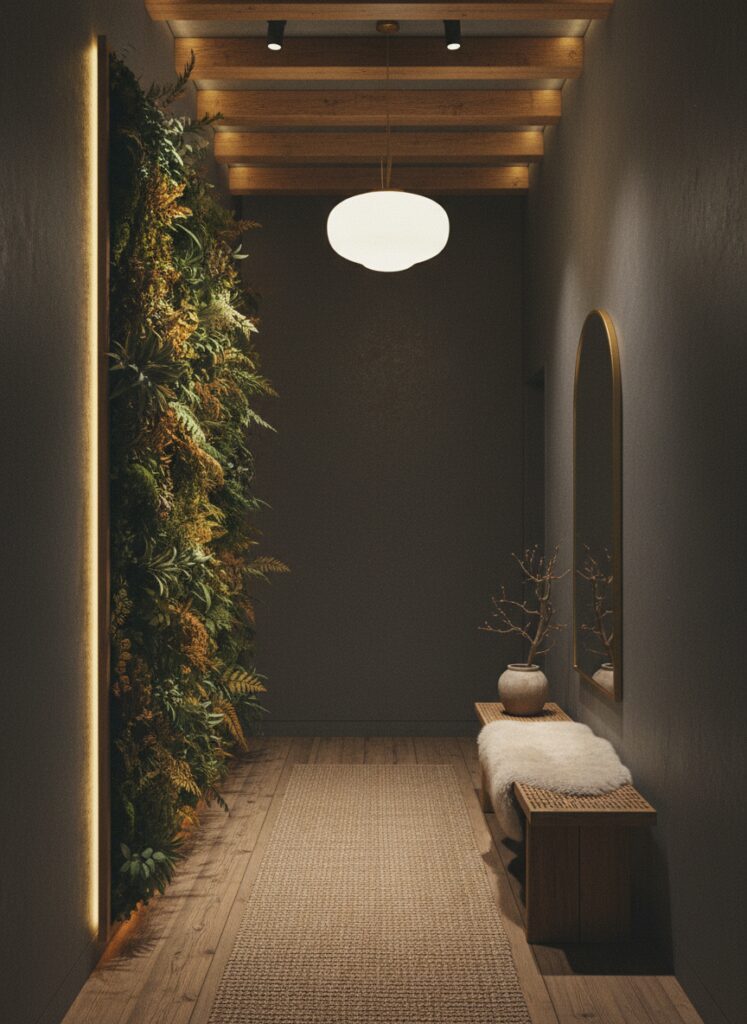
Treat the lighting of your green wall like an art gallery.
Use track lighting or directional sconces.
If you are renting and can’t hardwire, use plug-in sconces or clip-on lights hidden behind a piece of furniture. There are plenty of renter-friendly lighting hacks that allow you to direct light onto the leaves without exposing ugly cords.
When you light a living wall correctly, the shadows creates a texture that no wallpaper can replicate. It looks moody, expensive, and intentional.
The Mirror Trick
If you have a small room and you can only afford a small patch of green wall, you need to cheat.
Place a large mirror on the opposing wall.
Suddenly, your 4-foot vertical garden looks like an immersive greenhouse.
Reflections amplify the “biophilic effect” without doubling the maintenance. The mirror bounces the green color around the room.
This is a classic technique for making a small room look bigger, but when applied to vertical gardens, it creates an infinity-forest effect that is genuinely trippy in the best way.
Entryways and “Pause Points”
Living walls are most effective in transition spaces.
We often ignore the entryway. It becomes a dumping ground for shoes and keys.
But imagine walking in and the first thing you see is a lush, vertical tapestry of ferns. It creates a “pause.”
If you don’t have a real foyer (common in modern builds), you can create a fake entryway using a freestanding vertical garden unit or a tall, narrow bookshelf filled with trailing plants.
It establishes a boundary. It says, “The chaos of the outside world stops here.”
The “Mistake” Section: Do Not Do This
I have seen some absolute disasters in this category. Please, for the sake of your sanity and your wallet, avoid these errors.
1. Ignoring Drainage
Water has to go somewhere.
If you mount a planter directly to the wall without a catch basin or a way to remove the pot for watering, you will get mold.
Mold loves drywall. It eats it.
Always use a system where the water is contained. If you are using the felt pocket system, be careful not to overwater. The felt holds moisture, but gravity still exists.
2. Monoculture Boredom
Do not fill your entire wall with one type of plant.
Unless you are going for a very specific, hyper-modern architectural look with Boxwood (which usually looks fake anyway), vary your textures.
Mix wide, glossy leaves (Rubber Plant varieties) with feathery textures (Ferns) and trailing vines.
The contrast is what makes it look natural. If it’s too uniform, it looks like a plastic hedge at a cheap wedding venue.
3. Scaling Wrong
A tiny, 8×10 inch frame with three succulents hanging in the middle of a huge wall looks sad.
It looks like a postage stamp.
If you are going to do this, you have to commit to the scale. It needs to feel substantial.
Better to have a narrow, floor-to-ceiling strip of green than a small, lonely square floating in the middle of a blank wall.
If you can’t afford to fill a whole wall, use vertical storage units or tall shelving to frame the plants, giving the illusion of a larger installation.
The Maintenance Reality Check
I am not going to lie to you. This requires work.
It is a pet. A stationary, silent pet.
You need to touch the soil. You need to trim the dead leaves.
If you travel for work three weeks a month, do not install a living wall unless you have a trusted house sitter or an automated irrigation system.
However, the payoff is tangible.
The air feels different in a room with a living wall. The acoustics are softer. The visual noise of clutter is reduced because the focal point is so strong.
The High-Tech Future
By 2026, we are going to see more self-watering, app-controlled wall units.
They already exist, but they are clunky. The designs are getting slimmer. The tanks are getting easier to hide.
We are moving toward furniture that comes with integrated plant housing. Think bookshelves with built-in grow lights and waterproof liners.
This is the convergence of furniture design and agriculture.
Why This Matters
We spend 90% of our lives indoors.
That is a depressing statistic, but it is reality.
Gray floors. White walls. Beige sofas.
Our eyes are starving for complexity. We are hardwired to look for fractals—the repeating, irregular patterns found in nature.
A living wall provides that visual nutrition. It breaks the monotony of the manufactured box you live in.
It is bold. It is opinionated. And yes, it is a bit of a hassle to water.
But looking at a wall of thriving, chaotic, beautiful life while you drink your morning coffee?
It beats staring at a beige wall any day of the week.
Get your drill. Get some anchors. Go green, but go up.