
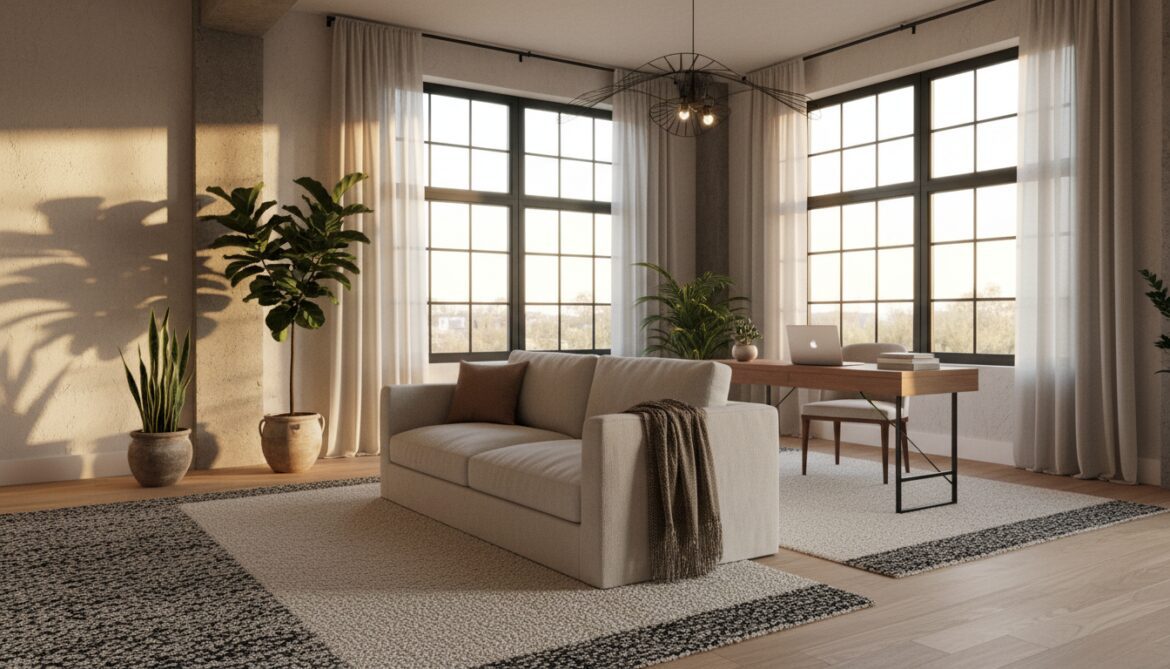
I used to think “open concept” was the holy grail of design. I was wrong.
It’s actually a nightmare if you live in anything smaller than a warehouse.
For fifteen years, I’ve watched clients tear down walls, only to realize they’ve destroyed the only thing keeping their sanity intact: separation. When you live in a studio, the industry tries to sell you on “airy” and “flow.” They are lying to you.
What you actually need is friction.
You need obstacles. You need to physically stop your brain from sliding off the sofa and into your email inbox. The biggest mistake studio dwellers make isn’t having too much stuff; it’s having too much visibility. If you can see your unmade bed while you are on a Zoom call, you have failed. If you can see the blinking light of your router while trying to sleep, you have also failed.
We are going to fix that.
The Theory of Micro-Zoning
Why does zoning matter? Because your brain is a simple, easily distracted machine.
It relies on environmental cues to release specific chemicals. Bed equals melatonin. Desk equals cortisol (or at least, focus). When those two zones bleed into each other into a beige mush, your neurochemistry gets confused. You end up tired at your desk and wired in your bed.
You don’t need drywall to build a wall.
You need visual disruption. You are essentially directing a stage play where the set changes without the curtain ever dropping. The goal is to create distinct “rooms” that just happen to share the same oxygen supply.
The Blueprint: How to Actually Do It
This isn’t about buying a folding screen and calling it a day. That is lazy design. We are going to restructure the architecture of your room using furniture and light.
1. The “Floating” Layout Strategy
Stop pushing all your furniture against the walls.
It is the most common amateur move I see. You create this massive, empty “dance floor” in the middle of the room that serves absolutely no purpose other than to highlight how small the rug is.
Pull the furniture into the center.
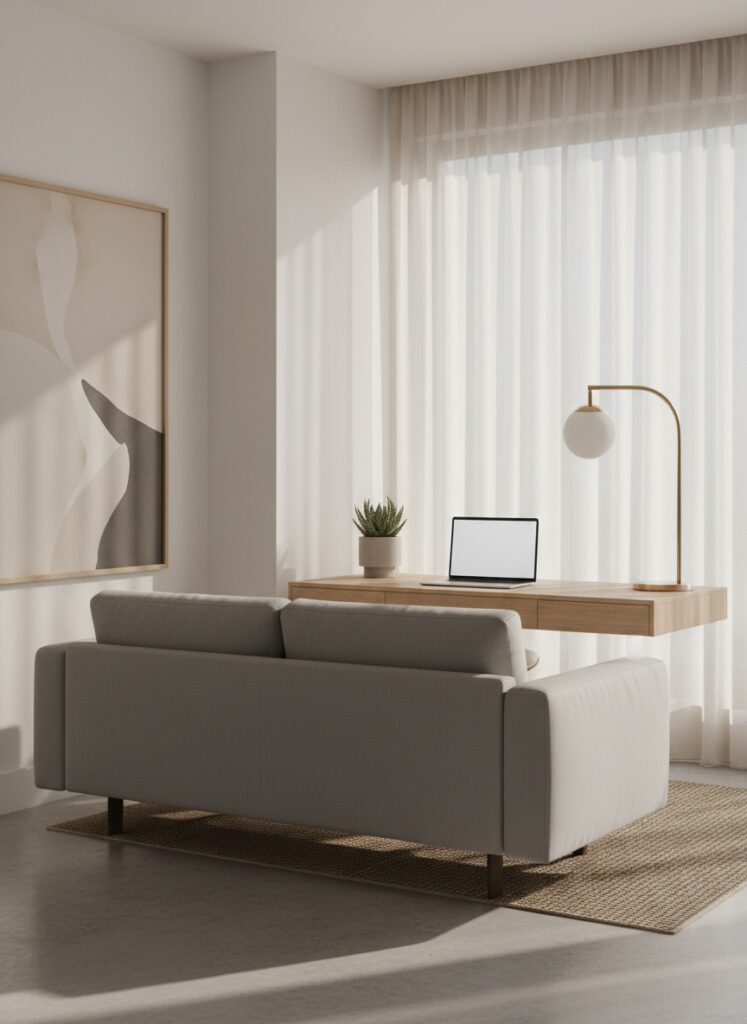
Use your sofa as a wall. If you place a slim desk directly behind your sofa, facing into the room or towards a window, you have instantly created an office. When you sit on the couch, the work is literally behind your back. Out of sight, out of mind.
Alternatively, float the bed.
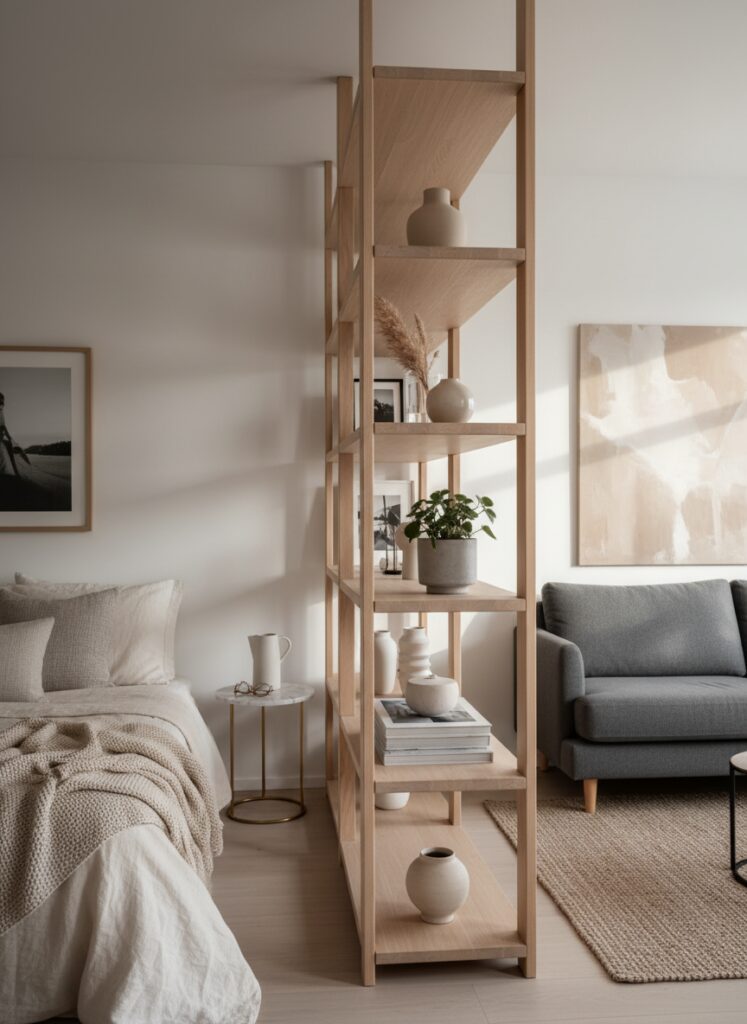
Place a sturdy, waist-high bookshelf at the foot of your bed. Place your desk on the other side of that bookshelf. Now, when you are sleeping, you see books and plants, not your monitor. When you are working, you see a library, not your duvet.
2. Vertical Storage as Architecture
You cannot afford to waste vertical space. In a studio, the air above your head is the most valuable real estate you own.
Tall, open shelving units are the best room dividers money can buy.
But here is the trick: do not stuff them full. If you pack every inch of a divider shelf with books and boxes, you block the light and make the room feel like a coffin. Leave negative space.
Use the shelves to house your office supplies on the lower levels and decorative objects higher up. This draws the eye upward, making the ceiling feel higher than it is. It creates a porous wall that defines the “office zone” without closing it off completely.
If you are renting, you might feel limited here. But there are ways to utilize wall space without losing your security deposit. You need systems that go up, not out. Tension rod systems or leaning ladders can act as visual markers between the “sleep” zone and the “work” zone.
3. Lighting is the Zoning Tool You Ignore
Most people rely on the “boob light” flush mount in the center of the ceiling.
Never turn that light on again. It flattens everything.
You need to use light to draw circles around your zones. The bedroom area needs warm, low-level lighting. Think table lamps or floor lamps with linen shades that diffuse the glow.
The office needs direction.
You want a task light that hits the desk and nothing else. This creates a pool of brightness that tells your brain, “Look here. Work here.” When the work day is done, you physically turn off the office sun.
This is especially tricky if you can’t hardwire anything. You have to get creative with plug-in options. Sconces that plug into the wall can save precious floor space next to the bed or desk, reinforcing that separation. It’s about creating different “vibes” for different times of day. You want to manipulate the atmosphere so that 9 AM feels visually distinct from 9 PM.
For more about this topic, read: Renter-Friendly Lighting Hacks
4. The Mirror Deception
Small studios often feel dark and cramped, especially when you start adding furniture to chop up the space.
You need to fake the volume.
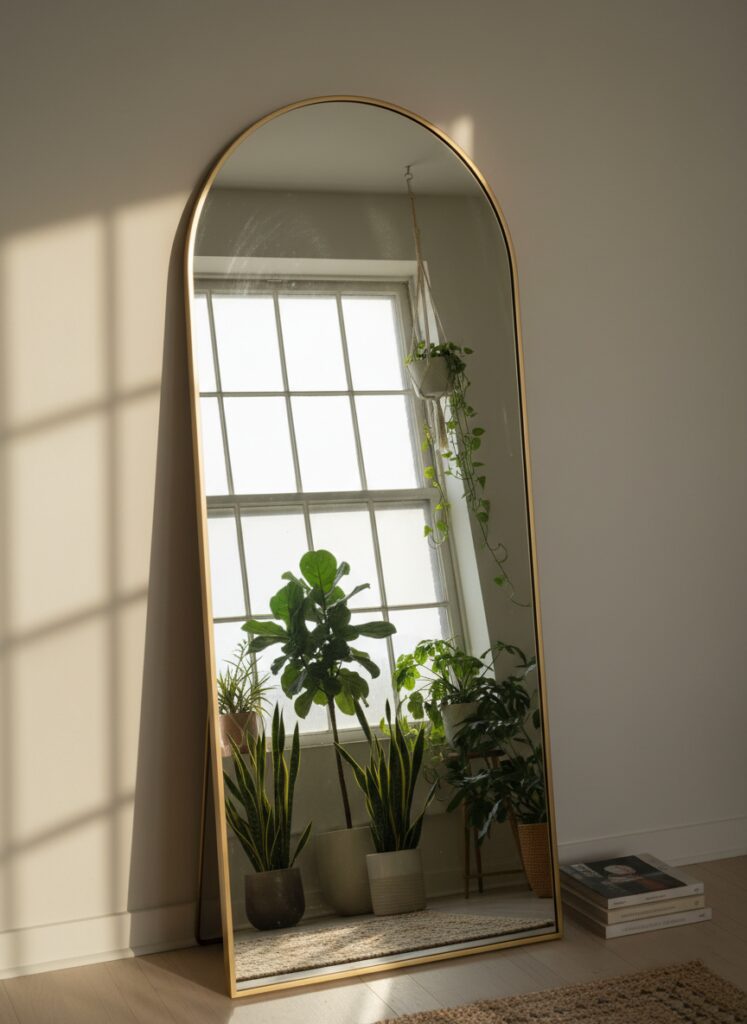
Large mirrors are not just for checking your outfit. They are architectural windows. If you position a large floor mirror correctly in your designated “office” area, it can reflect a window, effectively doubling the natural light.
This is a specific type of magic.
Suddenly, your cramped desk corner feels like an airy workspace. It reduces the feeling of being trapped in a box. However, be careful with placement in the bedroom zone. You generally do not want to see yourself immediately upon waking up; it can be jarring. Use mirrors to expand the active zones, and keep the sleep zones softer and more matte.
5. The Psychological Entryway
One of the hardest parts of working from a studio is that you never “arrive” at work. You just roll over.
You need a commute. Even if it is three steps.
You need a fake entryway.
Even if your front door opens directly into your kitchen or living space, you need to create a “landing strip.” A small console table, a specific rug, or a set of hooks. This is the transition point.
When you walk in the door, you dump your keys and coat. You wash your hands. Then, you walk to the desk. It sounds silly, but creating a dedicated “drop zone” stops your work bag from ending up on your bed. It contains the clutter of the outside world so it doesn’t infect your sanctuary.
This separation helps you mentally shift gears. It keeps the mud and chaos of the street away from where you sleep and where you think.
Where You Will Likely Fail (The Mistakes)
I see the same three disasters happen over and over again. Please, spare yourself the headache and avoid these.
Mistake 1: The “Aesthetic” Chair
I know you want that vintage wooden chair or the clear acrylic ghost chair because it looks invisible.
Don’t do it.
Your spine does not care about your Instagram aesthetic. If you are working from home for eight hours a day, you need a real ergonomic chair. It will be ugly. That is okay.
If you buy a hard, uncomfortable chair to save space or look cute, you will end up working from the bed within a week. And once you start working from bed, the zoning is dead. The bed becomes the office, the back pain sets in, and the depression follows. Buy the ugly comfortable chair and throw a sheepskin over it if you must.
Mistake 2: The Cord Spaghetti
Nothing ruins a calm bedroom vibe faster than a tangle of black wires snaking across the floor.
In a studio, your desk is likely visible from everywhere. If the underside of your desk looks like a nest of snakes, you will never feel relaxed.
Zip ties are cheap. Cable sleeves are cheap.
Velcro them to the leg of the desk. Mount the power strip to the underside of the tabletop. If I can see your plugs, you aren’t finished decorating. Visual noise is just as loud as auditory noise.
Mistake 3: Ignoring Acoustics
You zoned the visuals, but you forgot the sound.
Studios echo. If you are on calls all day, your voice will bounce off the hard walls and hit your partner (or your sanity).
You need soft things.
Rugs are mandatory. Not just for looks, but to absorb the clatter of life. If your desk is on a hardwood floor, every chair scoot will sound like a gunshot. Anchor your office zone with a rug. It adds another layer of visual separation—literally defining the “office island”—and it dampens the echo.
Curtains also help. Heavy velvet or wool curtains act as sound baffles. If you stick with flimsy blinds, you are living in an echo chamber.
Go Move Your Furniture
You don’t need a contractor. You don’t need a bigger apartment. You need to stop accepting the layout your landlord gave you.
Push the sofa. Turn the desk. Buy a lamp.
Reclaim your sleep.