
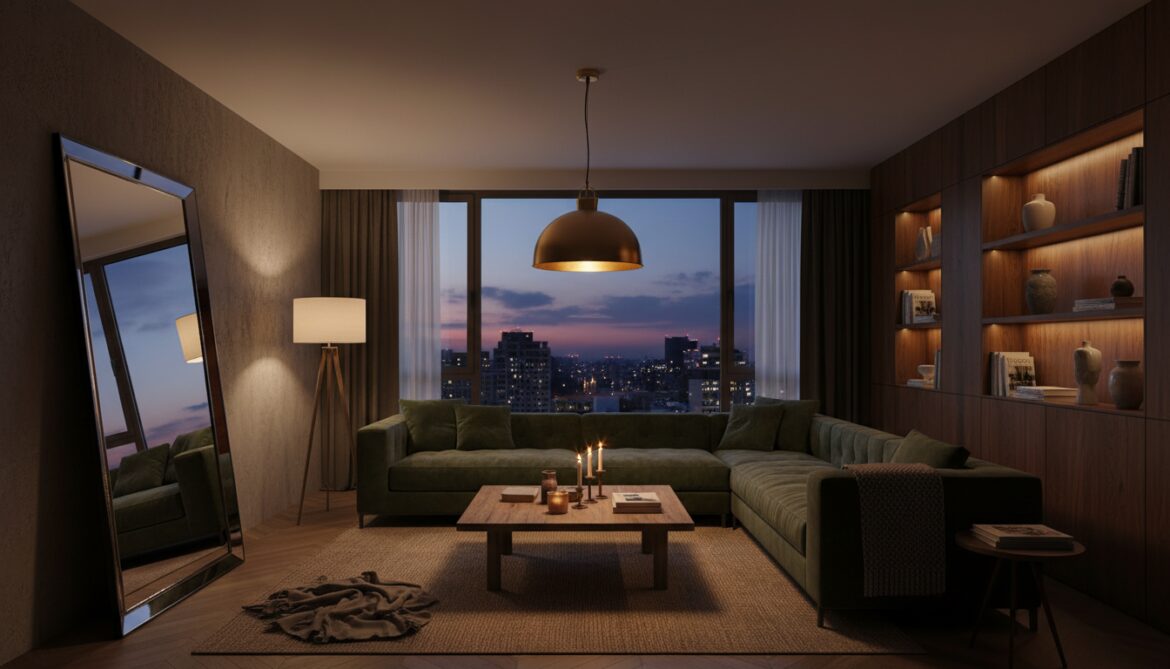
I have a confession to make, and it might get my design license revoked by the high council of aesthetics.
For the first three years of my career, I lived in an apartment with a “boob light” in the center of the living room, and I never turned it off. I just lived in that harsh, overhead interrogation glare. I complained that the room felt small. I whined that my furniture looked cheap. It wasn’t until I accidentally knocked over a table lamp at a thrift store—and felt obligated to buy it out of sheer embarrassment—that I realized I had been living in a visual prison of my own making.
Here is the cold, hard truth about rental lighting. Landlords do not care about your circadian rhythm. They care that the bulb turns on and that the fixture costs less than twelve dollars at a hardware liquidation sale. If you rely on the switch by the door, you are choosing to live in a hospital waiting room. Stop doing that.
The Theory of “Layered” Lumens
Why does a hotel lobby feel expensive while your living room feels like a college dorm? It isn’t the velvet sofa. It’s the fact that the light isn’t coming from a single, blistering source in the middle of the ceiling.
Lighting is architectural manipulation. When you cannot tear down a wall, you wash it in shadow. When you cannot install a dimmer, you bypass the circuit entirely.
You need to stop thinking about lighting as a binary state of “on” or “off.” Think of it as painting with electricity. You are creating pools of visibility and pockets of mystery. In a rental, where you are legally prohibited from touching the copper wires behind the drywall, this becomes a game of strategy. We are going to cheat. We are going to use plugs, batteries, and physics to trick the eye into thinking this space was designed, not just assembled.
The “Puck Light” Trick (and Why It’s Annoying But Worth It)
You have likely seen this on social media. It involves taking a cheap wall sconce, cutting the wires off the back, and gluing a battery-operated puck light inside the shade. Then you stick the sconce to the wall with heavy-duty adhesive strips.
Does it look good? Yes. It looks like you paid an electrician three hundred dollars to wire a fixture.
However, I need to be real with you about the battery situation. Most puck lights eat AAA batteries like popcorn. If you plan to use these as your primary reading lights, you will be changing batteries every week. It is a hassle.
But here is where you make it work for you. Use this trick for accent areas, not task areas.
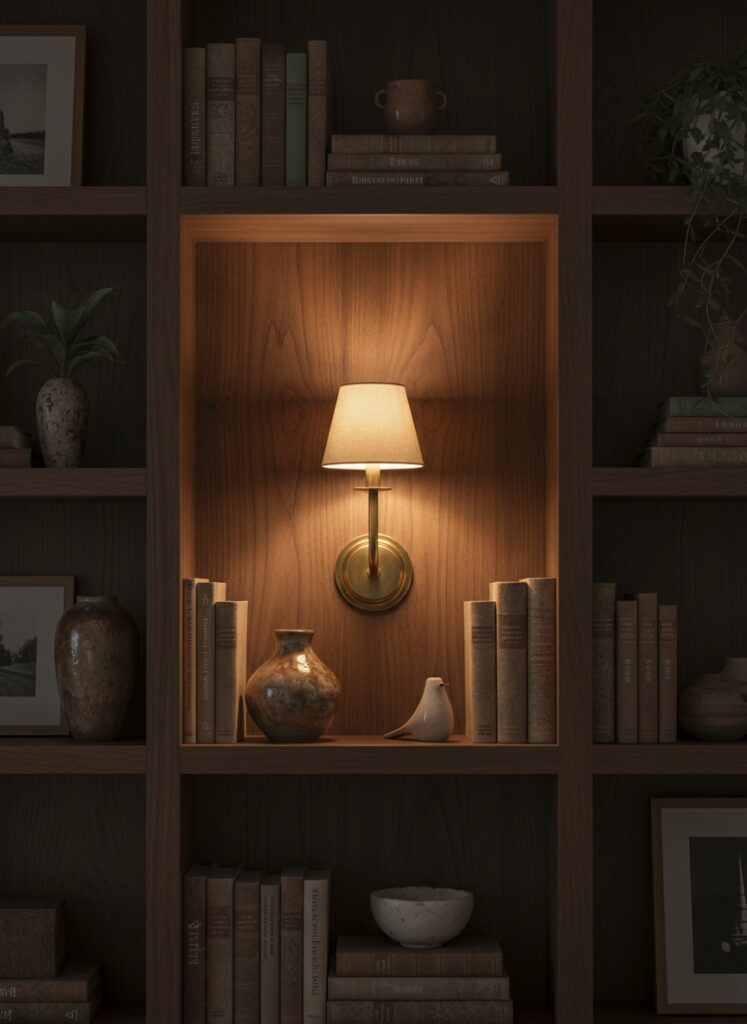
Think about those vertical spaces you are trying to utilize. If you have installed floating shelves or tall bookcases to maximize your square footage, a sconce mounted directly onto the shelving unit creates a library effect that is downright moody. It draws the eye upward. It highlights your books or that weird ceramic cat you bought in Portugal. By attaching a battery sconce to the side of a tall cabinet or shelving unit, you create a focal point that distracts from the bland beige walls.
Just buy rechargeable batteries. Buy eight of them. Keep a charger running. Do not lie to yourself and say you will go to the store when they die. You won’t. You will just have a dark sconce on your wall for six months.
The Plug-In Pendant: Embrace the Swag
For years, people tried to hide cords. They taped them. They painted them. They bought those ugly plastic raceway covers that never stick properly and just look like a PVC pipe is growing out of your baseboard.
Stop hiding the cord.
The “swag” lamp—a pendant light on a long cord that plugs into the wall and hangs from a hook in the ceiling—is a legitimate design choice. It feels intentional. It gives a room a relaxed, industrial, or mid-century vibe depending on the hardware.
This is particularly useful if you are trying to carve out a specific zone in an open-plan box. Let’s say you are trying to manufacture a foyer where there isn’t one. You have a shoe rack and a bench, but it still feels like the middle of the living room. Dropping a pendant light from a ceiling hook right above that bench defines the airspace. It creates a cylinder of light that says, “This is the entry. You stop here.”
For more about this topic, read: fake entryway ideas
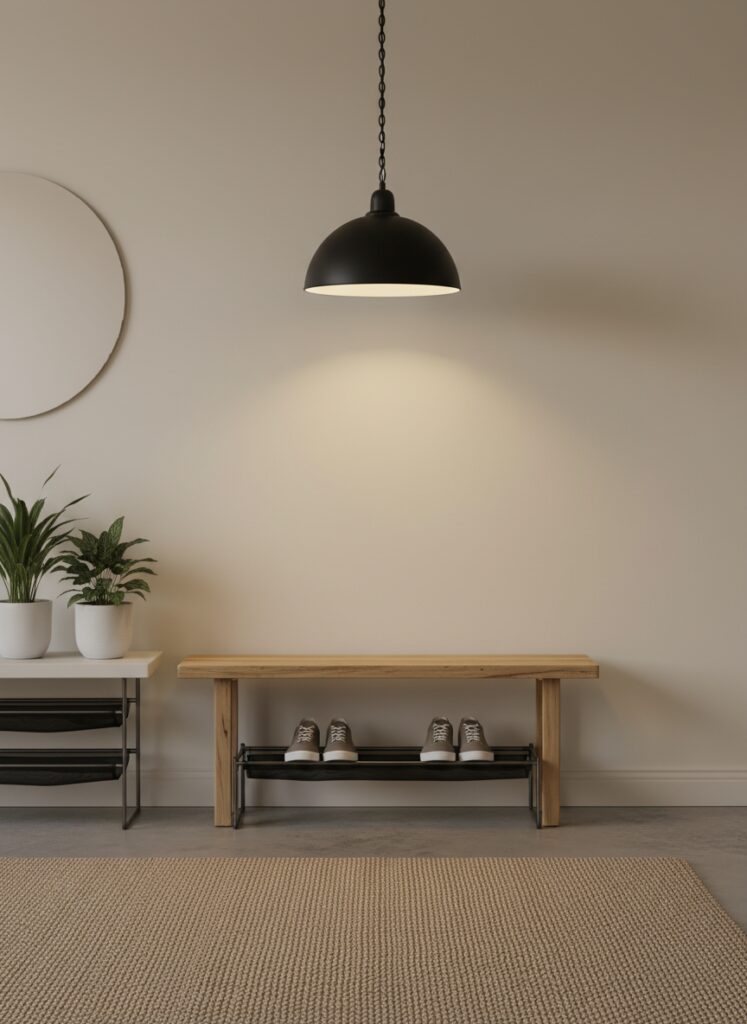
It anchors the furniture. Without the light, the furniture is just floating. With the light, it is a destination.
The Cord Management caveat
If you are going to swag a light, the cord needs to have slack. A tight cord looks like a mistake; a loose, curved cord looks like physics in motion. If the plastic cord that comes with the lamp is ugly, wrap it. You can buy fabric cord covers or even jute rope to spiral around the wire. It adds texture. Texture is what makes a rental feel like a home instead of a box.
Mirrors are Not Just for Narcissists
I cannot stress this enough: a lamp is only as good as the surface it hits. If you put a lamp next to a matte black wall, the light dies. It gets absorbed.
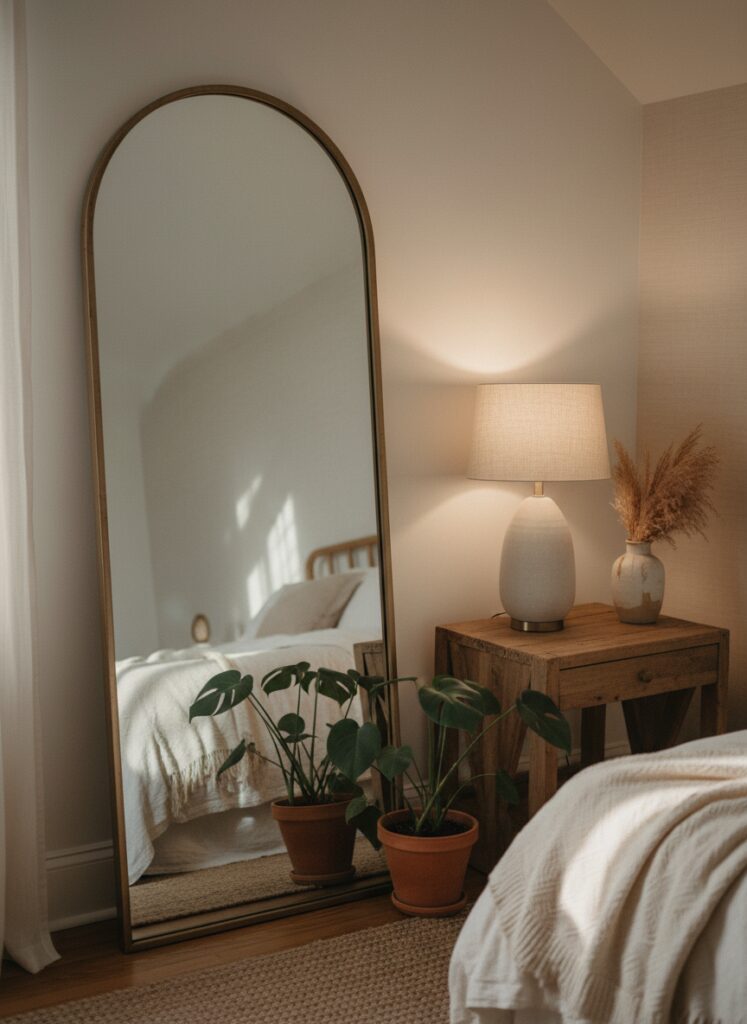
If you place a floor lamp or a table lamp directly in front of or beside a large mirror, you have just doubled your light output for free. You are bouncing those lumens back into the room. This is the oldest trick in the book for expanding perceived space, but specifically for lighting, it creates depth.
When you position a light source near a mirror, you also soften the glare. You see the reflection of the glow rather than the bulb itself. This is incredibly helpful in small, cramped rooms where you don’t have the floor space for three different lamps.
One mirror. One lamp. Huge impact.
Try this: Take a floor lamp with a translucent shade (linen or paper, never metal for this specific trick) and place it in the corner. Lean a tall floor mirror behind it. Suddenly, that dark, dead corner becomes a window into another world. It breaks the boxy geometry of a standard bedroom.
The LED Strip: Do Not Make Your Home Look Like a Gaming PC
LED strips are dangerous. In the wrong hands, they make your sophisticated living room look like a teenager’s basement setup.
The mistake people make is exposing the diode. You should never, ever see the actual little square light chip. It hurts your eyes and it looks unfinished.
If you are going to use LED strips (and you should, they are cheap and flexible), they must be diffused. Stick them on the underside of your kitchen cabinets to illuminate the counter. Stick them on the back of your headboard to create a halo effect against the wall.
But here is the specific nuance for renters: Color Temperature.
Most cheap LED strips default to a harsh, icy blue. It is often labeled “Cool White” or “Daylight.” Do not use this. It makes your skin look grey and your food look unappetizing. You want “Warm White” (2700K to 3000K). If you buy the color-changing RGB ones, keep them on a warm orange-yellow or a soft amber. Never set them to blue unless you are hosting a rave.
Under-cabinet lighting in a rental kitchen is the single biggest upgrade you can make. Rental kitchens usually have one dim overhead fixture that casts your own shadow onto the cutting board while you chop vegetables. It is dangerous and depressing. a $20 strip of LEDs stuck under the cabinet changes the utility of the room completely.
The Smart Bulb Solution
If you ignore everything else I have written, please just spend money on smart bulbs.
Rentals rarely have dimmers. Landlords love a simple on/off toggle switch because it never breaks. But atmospheric lighting requires dimming. You do not want 800 lumens of brightness at 10:00 PM when you are trying to wind down with a glass of wine.
Smart bulbs allow you to bypass the hardware limitations. You can dim them from your phone. You can schedule them to turn warm and dim automatically at sunset.
I screw these into everything. The bathroom vanity? Yes. If you have to wake up to pee at 3:00 AM, you do not want to be blinded by the sun. Set that bulb to 1% brightness and a red hue for the overnight hours. It saves your retinas.
Where People Mess This Up (The Mistakes)
I see the same three errors in almost every “renter-friendly” makeover I critique. Avoid these pitfalls, and you will be ahead of 90% of the population.
1. The Temperature Clash
You have a “Daylight” bulb (5000K) in the ceiling fixture and a “Warm White” bulb (2700K) in your floor lamp. When both are on, the room looks sickly. It creates a visual dissonance that makes you feel uneasy, even if you can’t articulate why.
The Fix: Check every single bulb in your house. They should all match. I prefer 2700K or 3000K for living spaces. Reserve the 5000K bulbs for the garage or an operating theater.
2. The “Uplight” Obsession
Those cheap floor lamps that look like a torch and shoot light straight up at the ceiling? They are terrible. They illuminate the popcorn ceiling texture and the cobwebs you haven’t dusted, while leaving the bottom half of the room in shadow. They create a “cave effect.”
The Fix: Buy lamps that cast light down or out through a shade. You want to light the furniture and the people, not the ceiling plaster.
3. Ignoring the Corners
Renters tend to cluster light in the middle of the room because that is where the outlets are usually convenient. This leaves the corners dark, which visually shrinks the room. Dark corners define the boundaries of the box.
The Fix: Run an extension cord. Hide it under the rug (tape it down flat so you don’t trip). Get light into the corners. When the corners are bright, the walls seem to recede, and the room feels larger.
A Final Word on Wattage
You do not need to accept the lighting plan your landlord gave you. Just because the socket is there doesn’t mean you have to use it.
I haven’t turned on my “big light” in four years. I navigate my home by a constellation of table lamps, shelf lights, and strategically placed glowing orbs. It requires walking around and flipping a few switches, or shouting at a smart speaker, but the payoff is a home that feels like a sanctuary rather than a storage unit.
Go change your lightbulbs. Right now. You look washed out in that fluorescent glare.