
I used to have a visceral reaction to large mirrors, and it wasn’t a positive one.
In my early years of design, around 2009, everyone was obsessed with that mirrored furniture look—you know the one. Dressers that looked like disco balls, nightstands that gathered fingerprints if you even looked at them sideways. It felt cheap. It felt desperate. I spent the better part of a decade ripping reflective surfaces out of clients’ homes because I wanted texture, not gloss. I wanted warmth, not the cold, hard stare of glass.
But I was wrong.
Or at least, I was looking at it through a lens of snobbery rather than utility.
When you are dealing with a 10×10 box—which is the standard size of a guest bedroom or a cramped city living room—you don’t have the luxury of ignoring the oldest trick in the book. You need to cheat. You need to lie to the eye. And nothing lies quite as beautifully, or as convincingly, as a massive sheet of silvered glass.
Why Your Brain Buys the Lie
So, why does this actually work?
It isn’t just “reflection.” That’s too simple.
It is about light trajectory and the interruption of visual boundaries. When you stand in a small room, your eyes hit the wall, and your brain signals: Stop. The world ends here. That signal creates claustrophobia. It tells your nervous system that you are contained.
A mirror acts as a breach in the hull.
By bouncing light back into the room, it confuses the brain’s depth perception mechanisms just enough to create a sense of continuation. It creates a phantom volume. You aren’t just seeing the room twice; you are seeing a version of the room that suggests air flow and pathways that do not exist.
In a 10×10 space, you are fighting for every visual inch. Dark corners are the enemy. Shadows make walls close in.
A mirror is not decoration. In this specific square footage, it is architectural salvage. It is digging a window where the contractor was too cheap to put one.
The Strategy: How to Actually Do It
If you just go to a big box store, buy a $50 wavy dorm mirror, and slap it on a wall, you will fail. You will just have a small room with a cheap mirror in it.
The execution requires a heavy hand and specific placement.
1. The “Fake Window” Technique
This is the most potent move you can make.
Find your light source. If you have a single window in that 10×10 dungeon, your mirror needs to live on the adjacent wall or the opposite wall. Not just anywhere. It has to catch the angle of the sun.
When you place a mirror opposite a window, you are essentially punching a second hole in the drywall.
But here is the trick: Go grid.
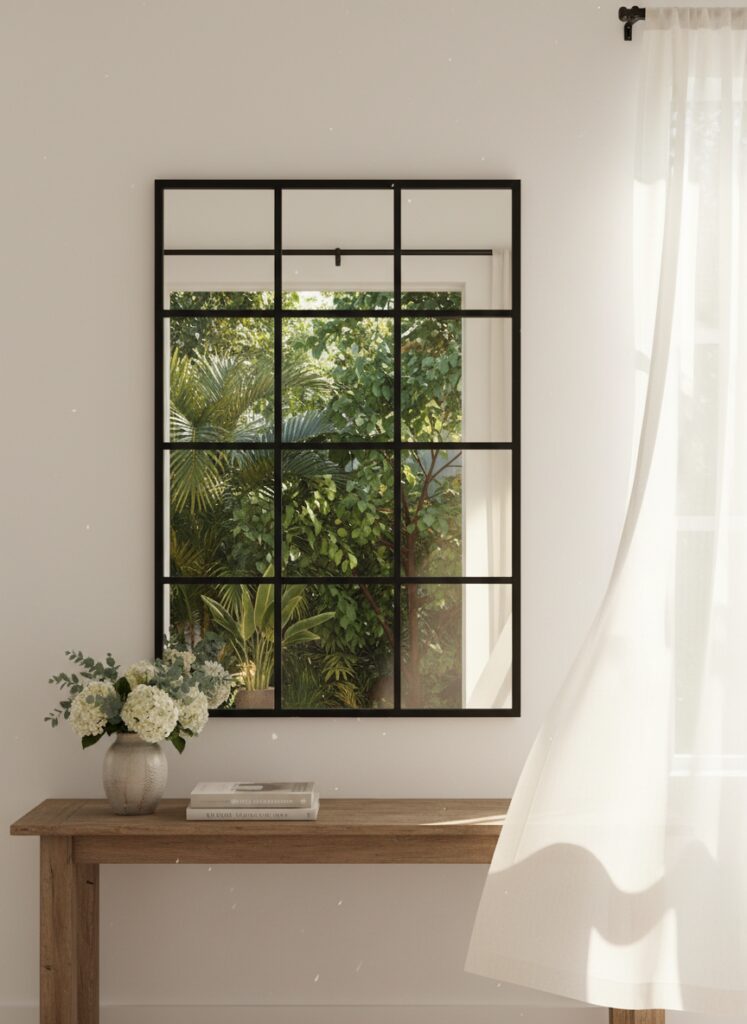
Don’t just use a flat sheet. Use a mirror with mullions (window pane dividers). The brain recognizes the grid pattern as “window” before it recognizes “mirror.” It’s a split-second cognitive delay, but that delay is where the feeling of space happens. I’ve walked into rooms I designed five years ago and still, for a fraction of a second, thought there was a view of the garden on the north wall.
It creates cross-ventilation for your eyes. The light comes in, hits the glass, and sprays across the darker side of the room.
2. Defining the Non-Existent Entryway
This is a specific pain point for people renting studios or older homes where the front door opens directly into the living space. You don’t have a hall. You have a door, and then you have a sofa.
It feels chaotic.
You can manufacture a sense of separation using a tall, leaning floor mirror.
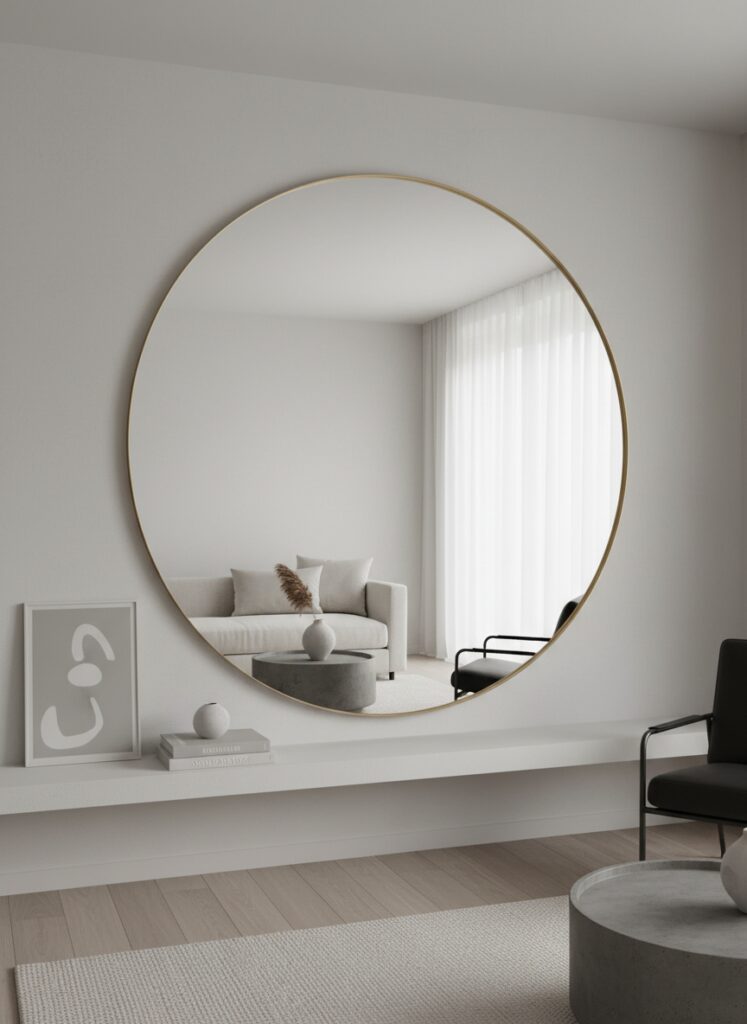
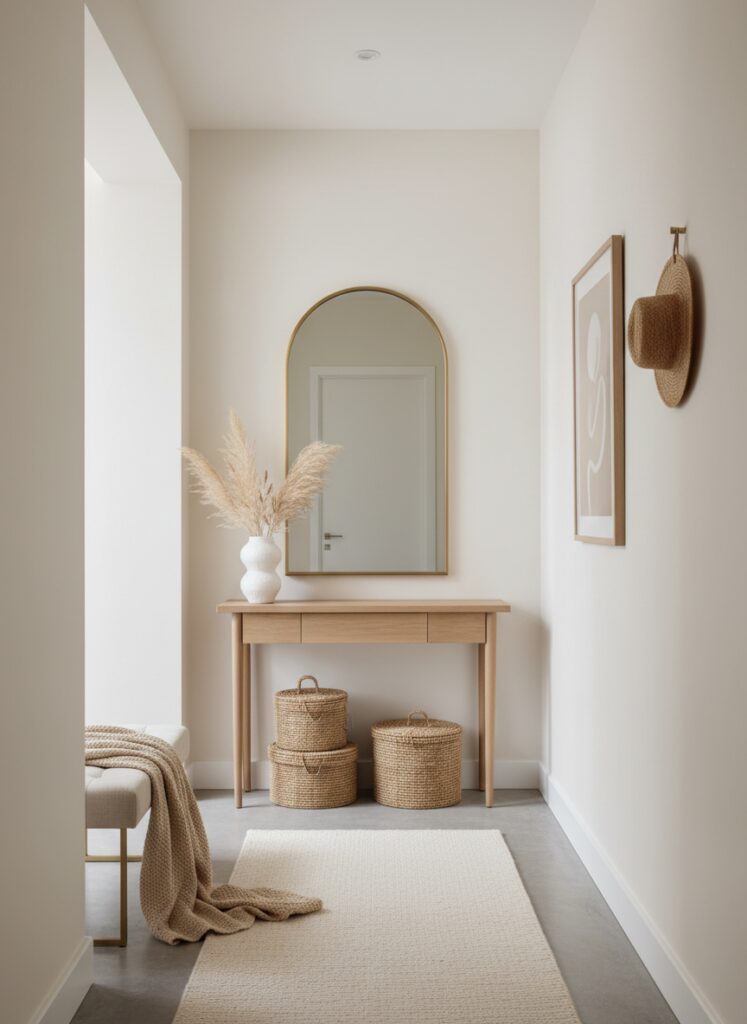
Here is how you do it: Place a narrow console table or a floating shelf next to the door. Lean a tall mirror (at least 6 feet high) right next to it, or hang a large round one above the console.
What does this do?
It creates a “pause” point. It signals to a guest that they are in a transition zone, even if that zone is only three feet wide. I talk about this constantly when dealing with open layouts—creating visual breaks is mandatory. If you are struggling with a layout where the door opens right into the living area, you need to verify how a mirror anchors that “landing strip.” It stops the eye from shooting straight to the TV or the unmade bed.
For those of you trying to figure out that specific awkward layout, look at how I structure fake entryway living room ideas for more context on furniture placement in that zone. The mirror is the anchor, but the table creates the barrier.
3. The Floor Lean (The Renter’s Best Friend)
If you are renting, you are probably terrified of drywall anchors. I get it. Losing a security deposit because you blew a crater in the plaster is not ideal.
This is where the oversized floor mirror saves you.
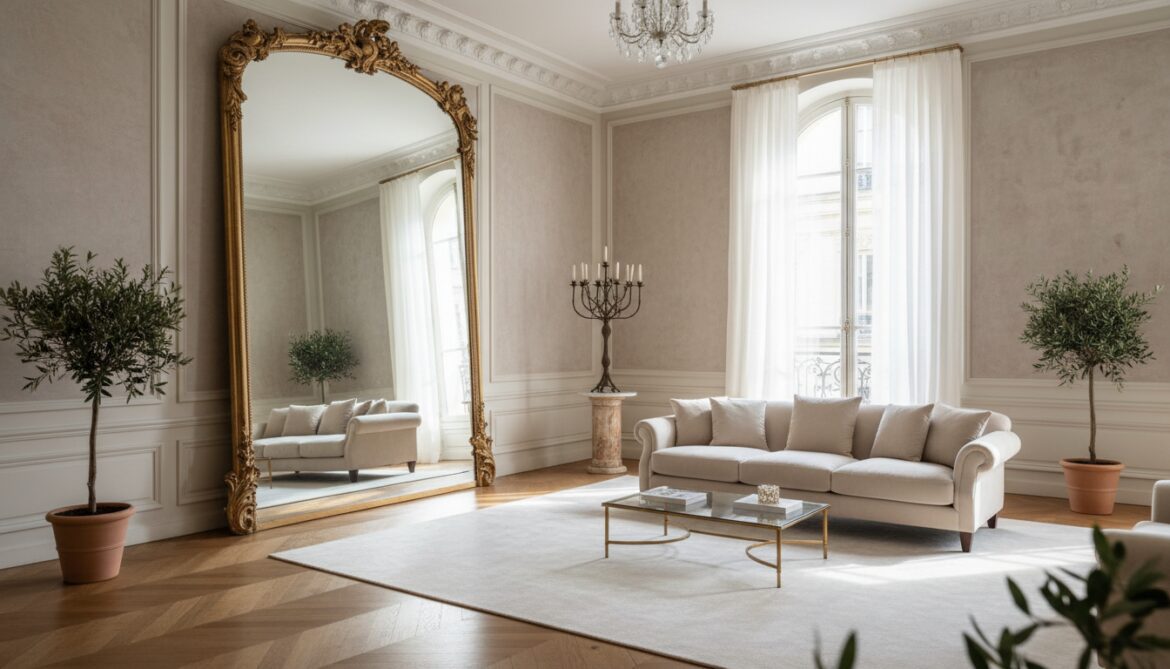
I am talking about the massive ones. The heavy, gold-framed, baroque giants or the sleek, iron-framed industrial slabs.
You lean it against the wall.
This does two things. First, the angle. Because it is leaning back slightly, it reflects the ceiling. This draws the eye up. In a small room, verticality is your friend. If you can’t make the room wider, make it feel taller. The reflection of the cornice or the ceiling fixture extends the vertical plane.
Second, it covers dead space.
A 10×10 room often has awkward corners where nothing fits. A chair looks cramped. A plant dies from lack of light. A floor mirror fills that void without taking up floor space. It consumes vertical volume while barely touching the footprint of the room.
4. Backing the Lamps
This is an old hotel trick, but it works in residential spaces if you aren’t tacky about it.
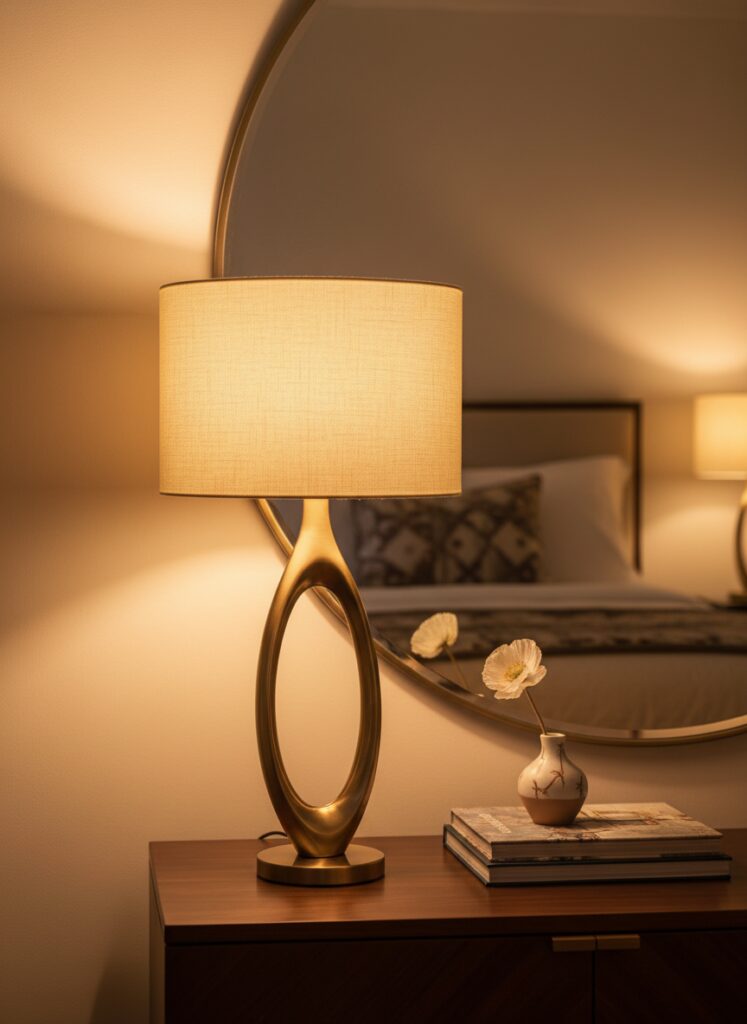
Place mirrors behind your light sources.
If you have bedside lamps, put small mirrors on the wall behind them. If you have a sconce, the fixture should ideally be mounted on a mirrored plate, or a mirror should be hung in proximity.
Why?
You are doubling the lumens without increasing the wattage. The glow bounces. In a small room, lighting is usually terrible. It’s either a harsh overhead boob-light or a single dim lamp. By backing your lamps with glass, you create a soft, diffused ambiance that pushes the walls outward. It blurs the edges of the room. When you can’t see the hard corners because of the soft glow, the room feels boundless.
Where People Screw This Up (Don’t Be This Person)
I see the same three mistakes over and over again. It drives me up the wall.
Mistake 1: Reflecting the Clutter
A mirror is a repeater.
If you point a mirror at your laundry pile, you now have two laundry piles. If you point it at a cluttered bookshelf or a messy desk, you have doubled your stress.
I walked into a client’s apartment last year, and she had hung a gorgeous, expensive antique mirror directly across from the open door to her bathroom. So, while sitting on her velvet sofa, you had a crystal-clear, high-definition view of the toilet.
Stop it.
Stand exactly where you plan to hang the mirror. Look at what is directly opposite. Is it ugly? Is it messy? If the answer is yes, do not hang the mirror there. You want to reflect art, windows, or blank walls. Nothing else.
Mistake 2: The Fun House Effect
Cheap mirrors warp.
There is nothing worse than walking past a mirror and looking like you’ve been stretched vertically or compressed like a squashed grape. Acrylic mirrors or those flimsy $10 “door hangers” are garbage. They have inconsistent surfaces.
In a small room, distortion is noticeable. It makes the space feel unstable and cheap.
You need glass thickness. You want a mirror that has weight to it. If you tap it and it sounds like plastic, leave it in the store. You are better off with a blank wall than a warped reflection that gives you a headache.
Mistake 3: Bad Feng Shui (or Just Bad Vibes)
I am not a strict Feng Shui practitioner, but some of the rules exist for a reason: human psychology.
Do not hang a mirror facing your bed.
I don’t care if you think it’s sexy. It’s unsettling. Waking up in the middle of the night and seeing movement in your peripheral vision triggers a primal “predator” alert in your brain. It disturbs sleep. In a 10×10 bedroom, you are already tight on space. Having your own reflection staring at you while you try to decompress is not relaxing.
Keep the mirrors on the closet doors or beside the bed. Never at the foot.
Mistake 4: Hanging it Too High
People treat mirrors like pictures. They hang them so the center is at eye level.
But for a mirror to expand a room, it often needs to be lower. You want it to reflect furniture and floor, not just the top half of the wall. When you see the floor continuing into the mirror, that is when the “extra room” illusion kicks in.
If the mirror is floating too high, it’s just a floating rectangle. It disconnects from the reality of the room.
A Note on Maintenance
I have to mention this because nobody talks about it until they are living with it.
If you commit to the “House of Mirrors” strategy to expand your space, you are committing to Windex.
Dust on a wall is invisible. Dust on a mirror destroys the illusion. A smudged mirror doesn’t look like a window; it looks like a dirty surface. It breaks the magic trick.
If you have a dog that likes to press its wet nose against glass, or a toddler with sticky hands, maybe keep the mirrors on the upper half of the wall. I have seen beautiful floor mirrors ruined by a daily layer of dog slobber. It’s gross, and it makes the room feel smaller because your eye focuses on the grime rather than the reflection.
Just Buy the Glass
You don’t need to knock down walls to fix a small room. You don’t need to paint everything white (please don’t paint everything white).
You just need to manipulate the light you already have.
Get a mirror that is slightly too big for the space. Ideally, one with a frame that contrasts the wall color so it looks intentional, not invisible. Prop it up. Angle it toward the sun.
Suddenly, you aren’t in a box anymore. You have room to breathe.